San Miguel de Allende, an Expat Mecca
The search for an expat life will take many people to world-famous San Miguel de Allende, Mexico. The spiritual center of Mexico and a UNESCO World Heritage city where thousands pilgrimage for Holy Week, San Miguel (SMA) is an expat's mecca, complete with vortexes, art, history, culture, famous people, and a nearly perfect climate.
It was our first stop in a six-year long journey to find a place abroad that we could call home. That journey has not ended but we have discovered much about the places we visited, the people we met, and ourselves.
Along this path, we published an anthology called At Home Abroad: Today's Expats Tell Their Stories. Hopefully our three-month stay in San Miguel will catapult you, as it did us, into the wonderful world of living at home abroad.
First Impressions
As our airport shuttle car approached the outskirts of San Miguel, we both sat in silence facing the same question: Have we made the right choice?
Farther into el Centro (downtown) on this bright sunny March afternoon, we found our thoughts lifting and the streets narrowing as our cab bounced along cobblestone streets lined with beautiful colonial buildings of red, blue and yellow gleaming in the sun. The jacaranda in bloom, along with all the magical sights brought the city to life. This was our introduction to the famous artist and expat haven we had read so much about.
After arriving at the La Quinta Hotel in the heart of the city, we found our way to the front desk to claim our reservations for March 7 and 8. We walked through the pretty courtyard and gardens to our $60 USD room. We unpacked for the two nights and then made our way to dinner at Olé Olé, a short right turn out of the hotel and down Loreto Street.
This restaurant had the reputation of having the best fajitas in town with the further inducement that it had been written up in Bon Appetit a few years ago. We ordered fajitas mixta and tortillas mixta (chicken and beef and corn and flour tortillas) and a cold Negra Modelo. We started talking about our day, ordering priorities for the next, but kept coming back to how in the world had they created the flavor of the fajitas. Our first meal in SMA complete, we walked outside as daylight was giving way and the long trip from Miami fading, making way for the lingering flavor of the fajitas. We wondered if our first dinner would serve as a metaphor for the rest of our stay. If so, it would be perfect.
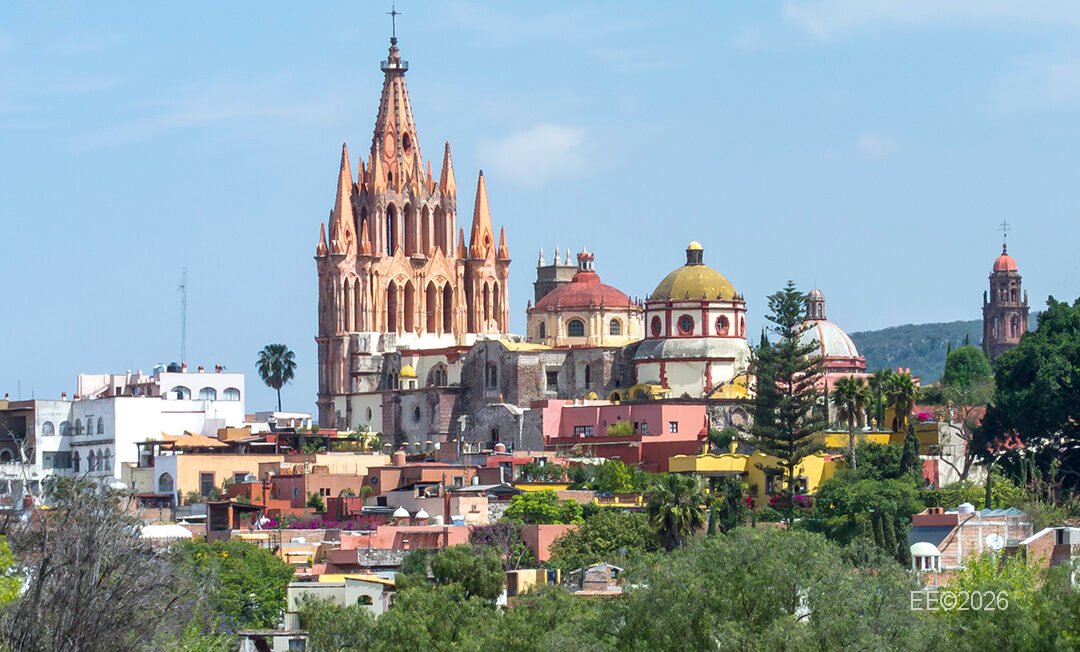
After dinner it was a short walk among the twilight-lit reds and yellows to el Jardin, the social center of San Miguel and our first close up view of the majestic La Parroquia across from the plaza.
This stunning church was built in the 17th century. Later in the 19th century a Gothic facade was added by Zeferino Gutierrez, an indigenous bricklayer and self-taught architect. The hues of the bricks provide a colorful contrast against the blue skies of SMA. It is said to be the most photographed church in Mexico, and there is no reason to doubt it.
Introductions
The following morning breakfast at the La Quinta hotel put our Spanish language skills to the test, eventually rewarding us with our first taste (not the last) of chilaquiles with eggs, an assortment of fresh fruit, and coffee. We were ready to see our new San Miguel home and meet the couple with whom we had arranged our three-month sublet via a local mail list and email.
Energized, we followed Bobbie's instructions for our planned meet-n-greet: "You come left through the artesanias market, up the steps, and staying to the left side, come to the sidewalk where the market ends. There is a sharp left, which is Animas. If you go straight, past the Farmacia Sagrada Corazon, you are on Homobono, go up the block, and turn left onto Presa… We will see you then."
At 10 a.m. as planned we rang the bell and were welcomed by Bobbie and Jose Luis who proved to be warm and generous people, people you feel an immediate bond with. As they showed us their home, we knew we had found a place that more than matched our expectations, the description and shared pictures. Spacious and nicely decorated with local and personal art, the house matched their personalities. The kitchen was fully stocked, including a shelf with cookbooks of local foods; it was obvious they loved to cook. The living space was comfortable, with eye-catching indigenous decorations, and designed for sharing conversation with friends and family. The bedroom included a king bed with plenty of closet space they had graciously cleared and a master bathroom large enough to accommodate two getting ready for the day.
Upstairs we found a deck lined with an assortment of flowers, a small studio apartment including full bath, fridge, and queen bed. From the deck, our courtyard below provided more space for entertaining and enjoying the outdoors. In central SMA at $800 a month including utilities, Internet, maid service twice a week, and a five-minute walk to el Jardin, this home was perfect.
Bobbie and Jose Luis were leaving for the U.S. early the next day so they were busy packing and preparing which meant our time together would be short. After lemonade in the courtyard and get-to-know-you conversation, we hugged, and well wished, with both couples sensing that the right choice had been made. We were handed the keys and gave them a check for the first month's rent.
We were given a full written set of detailed suggestions and instructions — what-to-dos, what-ifs, and personal favorites — which made our first few days so much easier.
Excerpts from the list:
· Doors Snugly Closed because there are insects in the jardinera who might want to come into the house (spiders and scorpions proliferate in the heat of April and May). Also, do not leave any food trash in the patio because feral cats will come to get it and leave a mess.
· Use Sin-Bac for cleaning fruits and veggies.
· Drinking Water. The garrafón of water is on top of the container, and that is what you need to use for drinking. We have left several bottles of water. It usually takes two people to handle the bottle. Always be sure to clean the top of the water bottle before opening it so that no dust accidentally gets into your water supply. Water is easily available at little tiendas on Animas and Presa, even the big bottles.
· Wonderful Bakery on Animas — just cakes, cookies, etc., no bread. It is on the opposite side of the street to the right when you open the door, about half block.
· Market to the left of Animas door, one half block with fruits, veggies, flowers, prepared foods (the shrimp cocktails are very good there), butchers, etc.
· Bonanza on Mesones has absolutely everything. Terrific in-town store.
· How much to pay cab drivers — 25 pesos when it is relatively close, 30 pesos when it is a greater distance. Give the person 25 and see how that works. Pay 30 pesos at night, and pay five pesos more if you have luggage or go to bus station. Always try to have the correct change — your life will be easier that way.
· How much to tip — always at least 10 percent, we usually do 15, but Mexicans tend to do 10.
· Tuesday is the Tianguis Market up at Salida Queretaro, and it is there all day, most people go early a.m. to afternoon. Plenty of good buys on everything you can imagine. You can plan to eat up there — fish, tacos, enchiladas, soups, shrimp cocktails, etc.
· Saturday is the Organic Market at Rosewood on Ancha San Antonio. Plenty of good things to eat.
· Semana Santa — Easter — you are going to be here, and I strongly encourage you to go to every event that you can. Everything will be listed in the Friday edition of Atencion. This is my favorite holiday period in San Miguel. Colorful, funny, poignant, jubilant — it has everything. It starts more than a week before Easter, so make your schedule.
Bobbie and Luis were an invaluable resource; we noted that in the future if we exchange homes or sublet to travelers, or just have visitors, we want to provide the newcomers with similar ammunition to make acquaintance with their new home and city.