by Mark | Nov 14, 2011 | Deep In It
3/24/2010
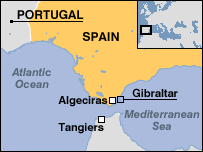
Our plane landed in Málaga, Spain on March 19, since then we have traveled to Ronda, Cadiz, Tarifa, and Gibraltar and now back to our beginning. Málaga is home to roughly a half-million people, about 100 km (62 mi) east of the Strait of Gibraltar and about 130 km (80 mi) north of Africa.
Note to self: do not enter large foreign city after dark looking for your hostel while driving a rented car and without a GPS device.
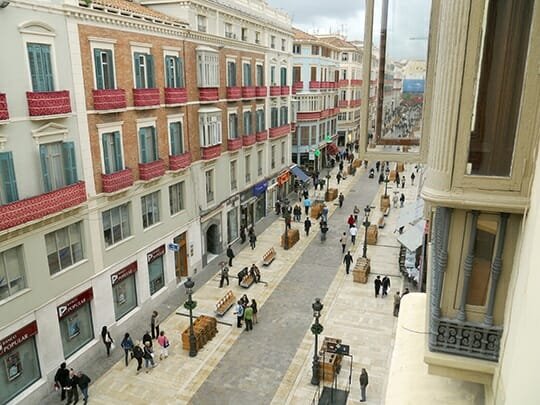
Street View from our Hostel Window
This time our hostel was well camouflaged along this busy walkway with a small sign of identification. After driving around and around honing in on this location, we parked along a dark and narrow street to proceed on foot. After entering the large wooden doors we hiked up a flight of stairs to check in. This hostel came highly recommended and lived up to its billing but it ain’t easy to find. The next morning we took the above photo from our room. I can remember only one hostel more difficult to find and that one was buried along the winding streets of Seville, Spain.
A bit about the city… Málaga’s history spans about 2,800 years, making it one of the oldest cities in the world. Founded by the Phoenicians around 770 BC, it was ruled by the Romans from 218 BC. After the fall of the empire it was under Islamic Arab domination until 1487 when Spain finally seized control. With the fall of Málaga, Granada became the only Moorish-controlled city on the Iberian peninsula after 800 years of rule. The archaeological remains and monuments from the Phoenician, Roman, Arabic and Christian eras make the historic center of the city an open museum.
Today, Málaga, while definitely a major economic center, has generated a growth in tourism served by Malaga Costa Del Sol Airport, one of the first in Spain, the fourth busiest and the oldest still in operation. The Port of Málaga is the city’s seaport, operating continuously at least since 600 BC. Rail service from the María Zambrano station connects Madrid and Barcelona with the new high-speed line making the trip to Madrid in considerably less than three hours. All of which, along with the great weather with lots of sunshine and Southern Spain beaches, makes Málaga a tourist destination but also a home to a sizable expatriate population of Brits and Germans.
For our visit, we targeted the birthplace of Pablo Picasso and the Museo Picasso Málaga, and the Gibralfaro castle which is next to the Alcazaba, the old Muslim palace which offered panoramic views of the city for our brief time in Málaga.
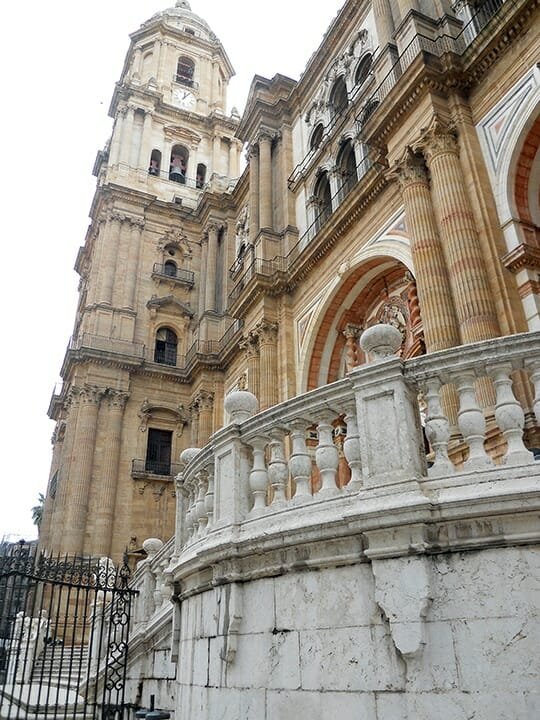
Cathedral of Málaga
The Cathedral of Málaga was the first major cathedral we visited after arriving in Spain. This Renaissance-style cathedral was constructed between 1528 and 1782. Two hundred and fifty years is incredible. The size and scope defies comprehension.
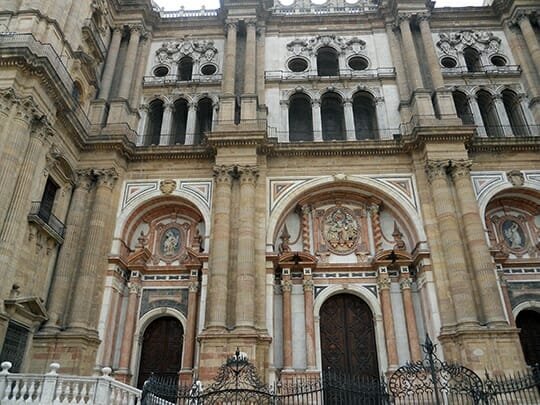 The inside is an awesome experience as one gazes at the enormity, the detail, and craftsmanship.
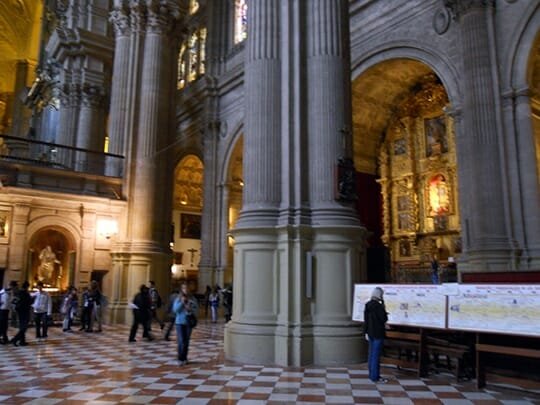
Inside the Cathedral of Málaga
The north tower rises 84 meters and is the second-highest cathedral in Andalusia, behind the Giralda of Seville. The south tower is unfinished. There are disputes on where the funds disappeared to, but because it is unfinished, the Cathedral has been nicknamed “La Manquita,” or in English, “The One-Armed Lady.”
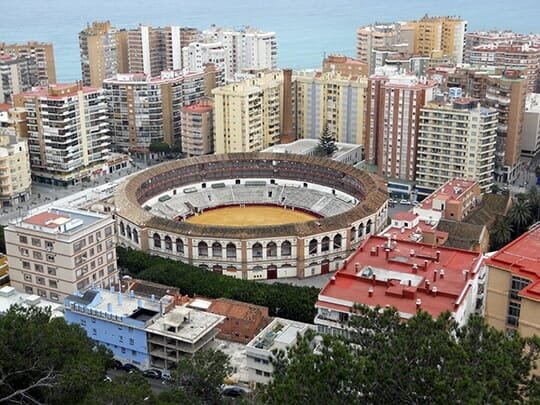
Having enjoyed visiting the birthplace of Picasso and the relatively new museo we took off for the walk up the hill to the Gibralfaro Castle with huge views over the city, including the Plaza de Toros de Ronda, one of the oldest operating bullrings in Spain.
The next road leads to Granada, Spain, where we will rent an apartment, experience Semana Santa, and immerse ourselves in the city for the next two months.
Mark Blondin, the next road …
by Mark | Nov 6, 2011 | Deep In It
3/23/2010
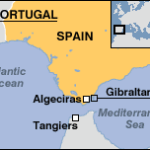
The next road from Tarifa, Spain, led to Gibraltar, which is more famously referred to as the Rock of Gibraltar. Did you know it is under British control? One minute you are driving along in Spain and the next, passing through British customs.
The history is long and storied and territorial control not a settled issue in Spain’s view. Statistically speaking, the Rock is 426 m (1,398 ft) high. The sovereignty of Gibraltar was transferred from Spain to Great Britain by the Treaty of Utrecht in 1713 after the War of the Spanish Succession. Most of the Rock’s upper area is covered by a nature reserve, which is home to around 300 Barbary apes (more on those later).
Atop the Rock is the Moorish Castle, a relic of the Moorish occupation of Gibraltar, which lasted for 710 years. It was built in the year A.D. 711, when the Berber chieftain Tariq ibn-Ziyad first landed on the Rock.
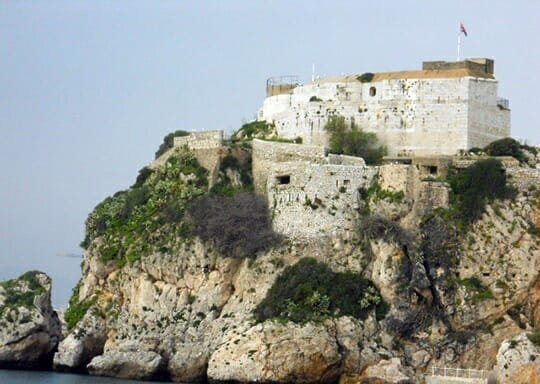
Moorish Castle, a relic of the Moorish occupation of Gibraltar, which lasted for 710 years
A unique feature of the Rock is its system of underground passages, known as the Galleries or the Great Siege Tunnels. The first of these was dug toward the end of the four years’ siege which lasted from 1779-1783. Having withstood long sieges, it seemed there was nothing that could destroy the Rock. This history has inspired the saying “solid as the Rock of Gibraltar.”
Our main goal was to see the Barbary macaque commonly referred to the Barbary ape because it lacks a tail. A colony of approximately 300 reside in caves near the top of the Rock, the only wild primates in Europe, most likely introduced from Africa. With dusk approaching we drove hurriedly along the steep and narrow road that leads to the top of the Rock.
You have to know that the road up the Rock is very narrow and curvy with only enough room for one car, and the Rock is very sheer. It is straight down 1,ooo feet to the ocean. The view was amazing and complaints of driving dangerously fast endless. But dusk was approaching.
We spotted our first ape about two-thirds up the Rock.
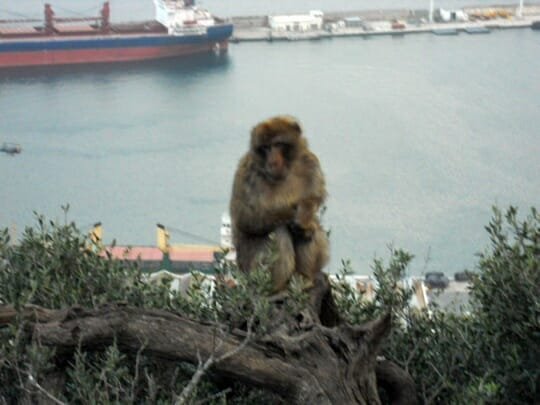
One of approximately 300 Barbary Apes on the Rock
Then they were everywhere.
Barbary apes are cute as can be, but they are known for their sharp teeth and bad temper so one is cautious, which helps to explain the blurry pictures. Stacy and I got out of the car and warily approached the apes.
Unfortunately, I inadvertently forgot to roll up my window. Added to that problem was that the car was parked very close to the sheer wall, which made getting out of the passenger side impossible. Sure enough, one of the apes decided to climb onto the car window and peer in. Betsy was trapped in the back seat.
Lots of screaming and yelling ensued, which fazed the ape not one iota, he barely paused then leaped onto the front seat to face Betsy. Breathing heavily with primordial lust, he grabbed the fruit salad from her hands, turned and scrambled out of the car window and ate the fruit—an expensive assortment she had bought in Tarifa. There he is with his ill-gotten treasure.

We were laughing so hard we could have fallen off the rock. We quickly noticed that Betsy was not laughing as much as she was recovering from her intimate encounter with the ape. He stole her fruit!
There was some talk that I was not “man” enough to fight off the ape or that I did not sacrifice myself to save my wife, but I did try to “shoo” it away. In my defense, I was in an awkward position in that the ape sat on the window sill for maybe two seconds, sizing up his prey before entering. My only recourse was to grab it by the nape of the neck to pull it backward. In that moment in time, attacking the ape did not seem like a wise course of action, especially given I was aware of their well-known temper issues (and sharp teeth). I think all was forgiven once Betsy escaped unharmed.
Our visit to Gibraltar was short but intense. Continuing to retell of the wild ape attack, we drove on and arrived in Malaga, Spain, late that evening. It was dark and busy, a big city of 500,000 people. Our hostel was not easily found and parking more difficult, but once we settled in, it was in a great location. The next day, we went to the Cathedral which is beyond words (200 years to build), the Castle and the home of Picasso.
One last view of The Rock…
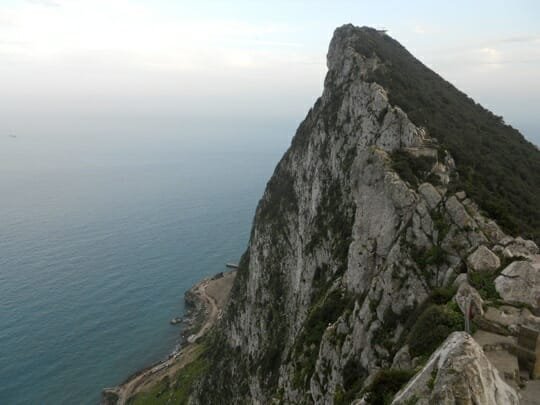
Majestic Rock of Gibraltar
by Mark | Nov 6, 2011 | Pulled Back
Some days you leave the house for a seemingly normal outing and then WHAM! life confronts you with the profound and wonderful where you least expect it. That’s what happened to us yesterday.
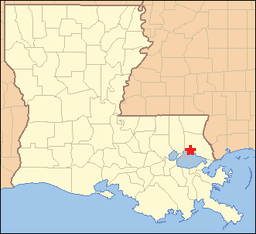
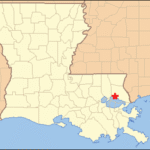
We left our temporary bayou home around 9:30 a.m. and drove to the pretty and historic town of Mandeville, LA. Where do I start… first we need a map.
The town of Mandeville was laid out in 1834 by developer Bernard Xavier de Marigny de Mandeville. It soon became a popular summer destination for well-to-do New Orleanians wishing to escape the city’s heat.
In the mid-19th century, regular daily steamboat traffic between New Orleans and Mandeville began. Bands would play music on the ships crossing the lake. Mandeville became one of the first places where the new “jazz” music was heard outside of New Orleans. Bunk Johnson, Buddy Petit, Papa Celestin, George Lewis, Kid Ory, Edmond Hall, Chester Zardis, and many other early jazz artists regularly played in Mandeville.
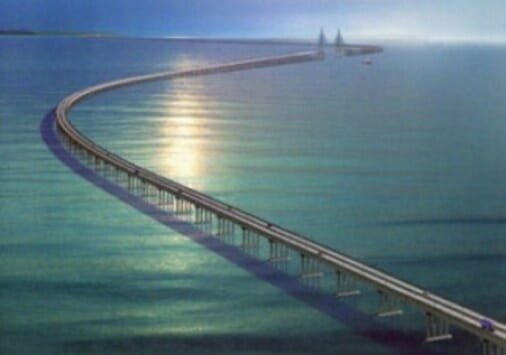
Okay, you have the setting. But let me add some perspective on the size of Lake Pontchartrain. The Lake Pontchartrain Causeway consists of two parallel bridges crossing Lake Pontchartrain. Since 1969 it has been listed by Guinness World Records as the longest continuous bridge over water in the world.
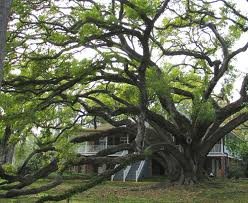
 One more point of interest: the Seven Sisters Oak, located in Mandeville, is the largest certified southern live oak tree. It is estimated to be up to 1,500 years old with a trunk that measures 38 feet (11.6 meters). This oak is also the National Champion on the National Register of Big Trees and the Champion Oak of Louisiana according to the Louisiana Forestry Association. The Seven Sisters survived a near direct hit from Hurricane Katrina in August 2005.
Our plan for the day was pretty simple. We bought a Living Social coupon for Mande’s restaurant in Mandeville and from there we were headed across the Causeway to New Orleans to hang out at the park along the Mississippi and then get groceries and from there, who knows…
Breakfast at Mande’s in Mandeville. Wow! Best breakfast ever! Anyone can do eggs. Who wants to debate omelettes? Sure, some want to compare bacon or sausage. Boring!
Here is the review of Mande’s restaurant on Yelp. Notice the mention of “best eggs Sardou EVER.” Eggs Sardou is a rich combination of poached eggs on English muffins with a slice of tomato, smothered in a spicy artichoke and creamed spinach Hollandaise sauce. Unless you can conceive of such a creation, it is time to close your restaurant. Ham and eggs… get out a here.
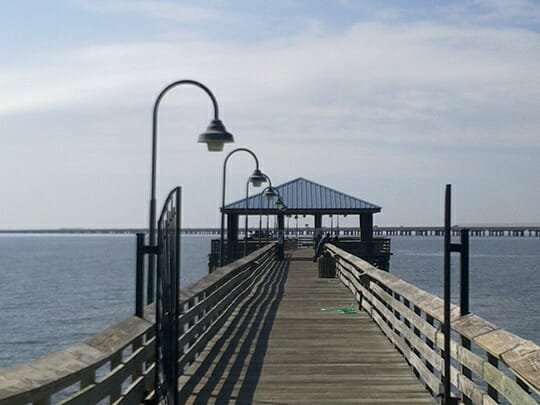
After that epicurean delight, we made our way to the lake and parked at a long pier with a majestic view. It was a clear, sunny day, the temperature around 70 degrees. The walk out on the pier was simply lovely.
We passed a handful of fishermen as we made our way along the pier remarking on the different birds, the warmth of the sun, and the beauty of the lake. The next few moments caught us in one of life’s unpredictable wonders. As we approached the end of the pier, a man casting a line into the lake stopped us and said we might not want to walk to the end.
We were speechless as he explained that a fellow fisherman had apparently died in his chair while fishing. During the course of some general fisherman banter, the man did not respond and it was then discovered that he was not breathing.
The man died, in this quiet, peaceful and beautiful setting doing what he loved. Trying to grasp how perfect his passing was, our thoughts gave way to the world around us.
Soon after, the EMT’s and police arrived. There were questions like who was he, what about his family, when did he die, how long had he been fishing, was he alone. But none of that seemed to matter. It was perfect.
You hear from people that they want to die this way or that. They imagine how their life will end, yet very few realize their moment. This man did.
We never made it to the end of the pier. It was enough. This ending was perfect.
by Mark | Oct 31, 2011 | Pulled Back
On the next road from Washington, D.C., to New Orleans, leading through Montgomery, Alabama, we relived the powerful history that brought us a step closer to a more perfect union. It was a short but impressionable stop in the birthplace of the Civil Rights Movement.
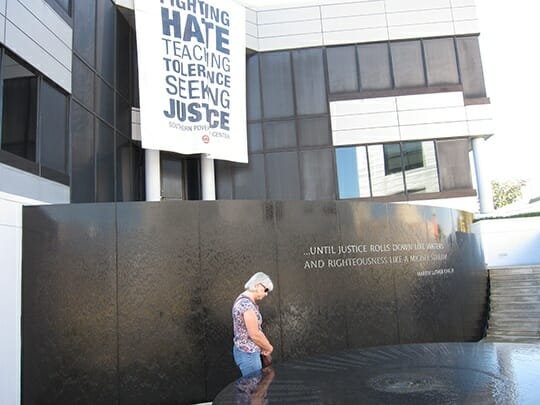
Civil Rights Memorial located at the Southern Poverty Law Center
We started at the Civil Rights Memorial located at the Southern Poverty Law Center in walking distance of many historical landmarks of that era. The memorial, interestingly enough, was designed by Maya Lin who also designed the Washington D.C. Vietnam Memorial.
In 1981, when she was 21, her entry for the Vietnam Memorial was chosen out of a field of 1,421 submissions in a design competition open to all Americans. At 28, she was asked to design the Civil Rights Memorial. The water-washed surface of the table is inscribed with the names of 40 people who died in the struggle for civil rights between 1955 and 1968, as well as with landmark events of the period. The water motif was inspired by Martin Luther King Jr.’s well-known paraphrase of Amos 5:24 – We will not be satisfied until justice rolls down like waters and righteousness like a mighty stream. Powerful words that spoke to long pent up feelings.
Inside the memorial, the displays tell the stories of the 40 who died and speak to injustices throughout the world.
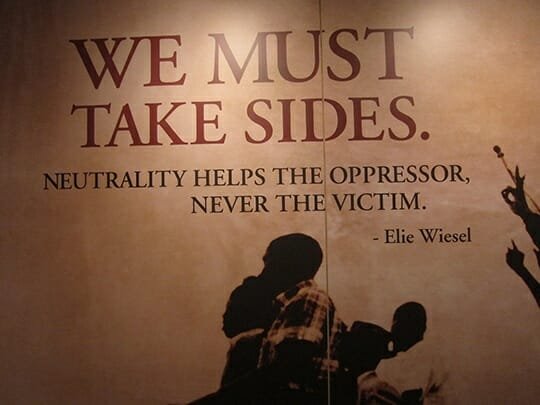
One of the 40 who took sides …
March 25, 1965 · Selma Highway, Alabama
 “Viola Gregg Liuzzo, a housewife and mother from Detroit, drove alone to Alabama to help with the Selma march after seeing televised reports of the attack at the Edmund Pettus Bridge. She was driving marchers back to Selma from Montgomery when she was shot and killed by a Klansman in a passing car.”
Viola’s story gets more interesting. Among the murderers in the car was an FBI employee, Gary Rowe (undercover), who was indicted in 1978 and tried for his involvement in the murder.The first trial ended in a hung jury, and the second trial ended in his acquittal. The FBI under J. Edgar Hoover played a large role in attacking and undermining the Civil Rights Movement and Martin Luther King Jr. in particular as detailed in Final Report of the Select Committee to Study Governmental Operations. Some believe Hoover was instrumental in the assassination.
The events of Bloody Sunday, the culmination of the three Selma to Montgomery marches, were broadcast on national television including the attack dogs, beatings and fire hoses. The violence unleashed on marchers was under the direction of Theophilus Eugene “Bull” Connor who came to symbolize the murders, hangings and sheer brutality that was brought to bear against those seeking basic civil liberties and social justice.
The national attention on the Civil Rights Movement forced Americans to come to terms with the legal and moral issues and culminated in the Civil Rights Act of 1964 and a year later, the Voting Rights Act of 1965. Difficult as it is to believe and understand, it took 100 years after the end of the Civil War to encode basic civil rights that were denied to Blacks in much of the South.
Leaving the Civil Rights Memorial, we walked to the Dexter Avenue Baptist Church where Dr. Martin Luther King pastored from 1954-1960.
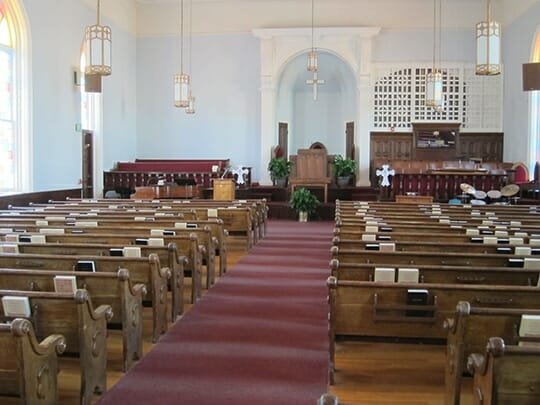
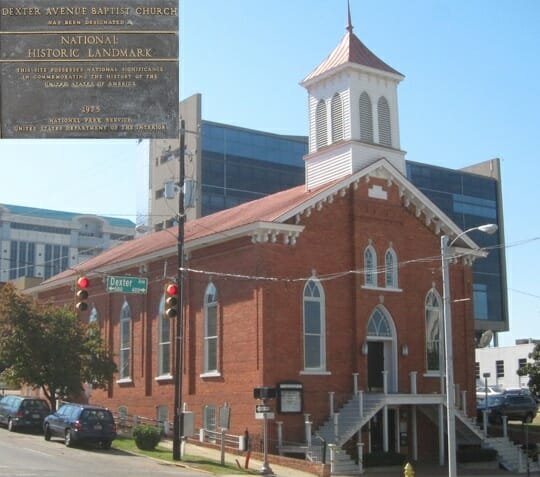 Although many Black churches were burned and bombed during the movement, including the 16th Street Baptist Church in Birmingham on Sunday, September 15, 1963, where four girls were killed, the Dexter Avenue Baptist Church was spared. Makes one wonder about divine intervention. A view inside the church… the pews are handmade and date to the 19th century.
 Ironically enough, from King’s office window he had a view of the Alabama State Capitol Building which served as the first political capitol of the Confederate States of America in 1861, before it was moved to Richmond, Virginia. In the Senate Chamber the Provisional Constitution of the Confederate States was drawn up by the Montgomery Convention on February 4, 1861. The convention also adopted the Permanent Constitution here on March 11, 1861. Over 100 years later the third Selma to Montgomery march ended at the front steps of the same building.
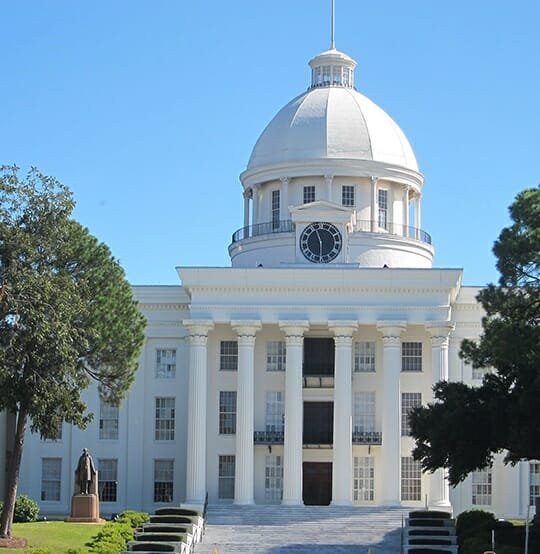 While Montgomery served as the first Capitol of the Confederate States of America, the newly elected Jefferson Davis lived in the first White House of the Confederacy.
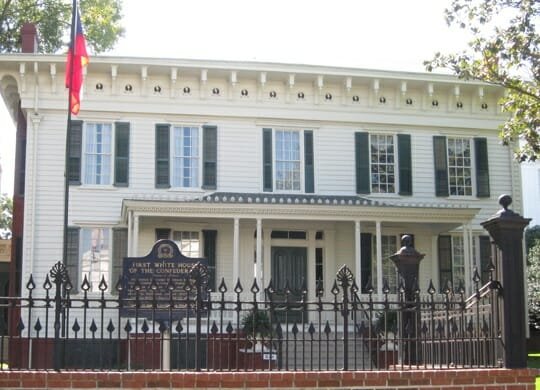
With time running short we missed the Rosa Parks Museum dedicated to the woman who refused to give up her seat for a white man, an act that sparked the infamous Montgomery Bus Boycott. Parks eventually received many honors including the Presidential Medal of Freedom, the Congressional Gold Medal and a posthumous statue in the United States Capitol’s National Statuary Hall. At her death in 2005 she was granted the honor of lying in honor at the Capitol Rotunda.
We left Montgomery all too soon, leaving much more to see and do. For the next few hours driving on the next road, we talked about all that we had seen and what can be done to participate in the search for social justice. The work of the Southern Poverty Law Center is integral to that effort. Their mission: “The Southern Poverty Law Center is dedicated to fighting hate and bigotry, and to seeking justice for the most vulnerable members of our society” is one that most of us can support.
As we traveled farther down the next road, we discussed the fact that perhaps we are witnessing the growth of a new movement, one seeking economic justice. While the Occupy Wall Street Movement continues to spread across the nation and throughout the world, we begin to consider the issues of poverty, health care, hunger, gross inequalities in wealth and all that entails for our citizens but also for the world. Economic justice may be the central moral question of our day.
The march to a more perfect union never stops. But after witnessing the painful civil rights history, it is worth considering that there must be a way to speed up the pace.
This post ends with a photo from Walden Pond and a quote from Ralph Waldo Emerson…
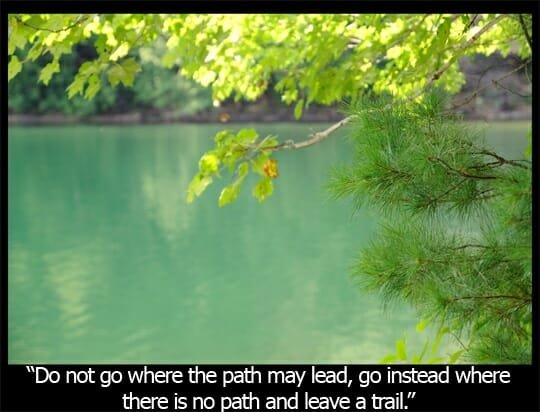
Photo of Walden Pond by Kelly (quote inserted)
by Mark | Oct 19, 2011 | Pulled Back
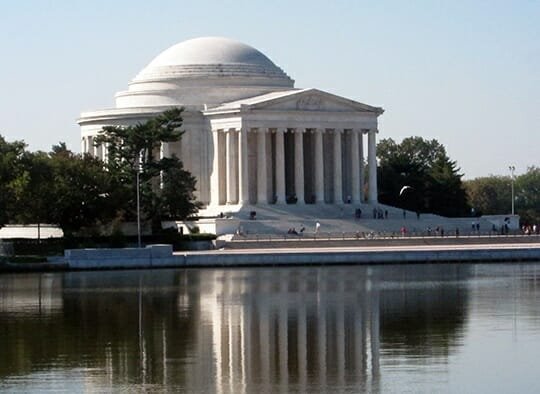
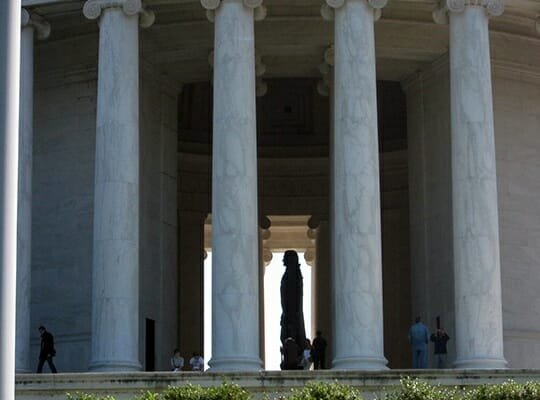
“The spirit of resistance to government is so valuable on certain occasions that I wish it to be always kept alive.”
Thomas Jefferson
Jefferson Memorial
It seems a spark has been lit spreading open rebellion against the greed and corruption in the corporate world and its control of the political process. The movement started in Zuccotti Park (formerly Liberty Plaza) and spread like a chain letter to over a 100 U.S. cities and worldwide. Early on the movement was met with skepticism and “dirty hippie” epitaphs but now garners over 52 percent approval from those following the story closely. In New York City that number approaches two-thirds. Given the shoddy corporate media coverage, as more people begin to follow this story closely, these numbers are sure to grow.
We might have a movement, or as Jefferson suggested an attention to public affairs. Having spent a few days here in Washington D.C. attending October 2011 and Occupy DC, a bus trip to New York City to get a first-hand view of the birth of the movement seemed important.
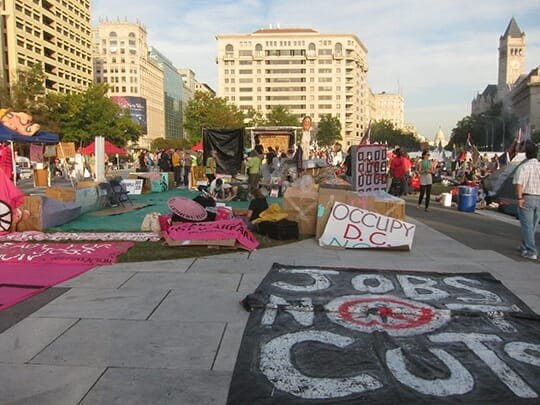
Freedom Plaza, Washington D.C.
Watching the distorted news coverage of Occupy Wall Street that seemed to purposefully paint a negative image of the occupy movement, I was surprised by the size of the location and scope of activity.
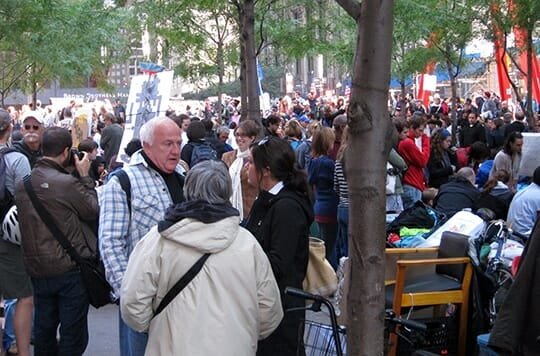
Liberty Plaza aka Zuccotti Park
What I saw in Zuccotti Park was much different than what the mainstream media portrayed and 180 degrees from right-wing Fox News coverage. If I were part of the 1% rather than the 99%, I would be mildly concerned. While barely a month in the making, these people have entrenched impressive organizational strides. They are discussing serious issues searching for a consensus that can jell into a platform for radical change in our politics and society. These people are for real.
Some of the impressive infrastructures I noticed were basic but well implemented like a kitchen and pantry…
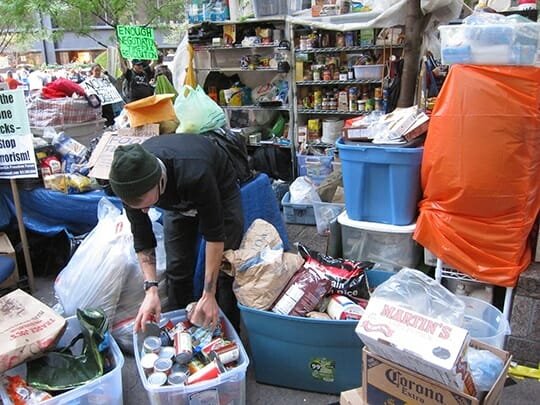
Food Pantry
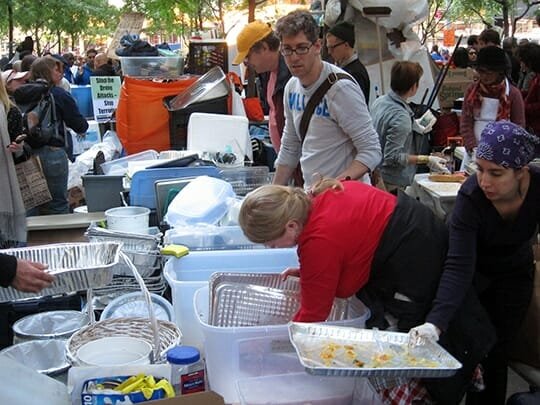
Kitchen
A well stocked “People’s Library” started by Betsy Fagin, a graduate of Vassar and Brooklyn College.
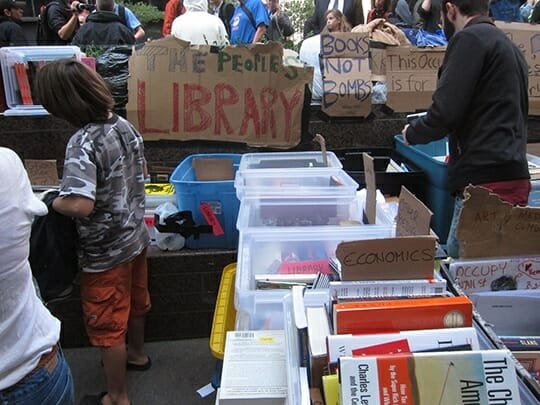
People’s Library
Basic necessities in this area called “Comfort Station” including hats, mittens, sweaters and boots seem to be stockpiled, portending a protracted stay.
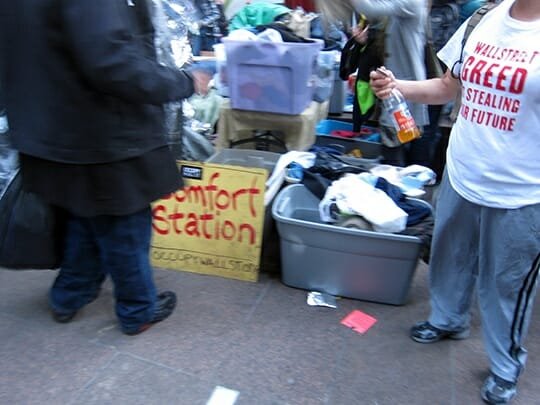
Comfort Station
Does this level of sophistication look like the work of “dirty hippies,” or committed activists seeking what Jefferson called a “spirit of resistance?”
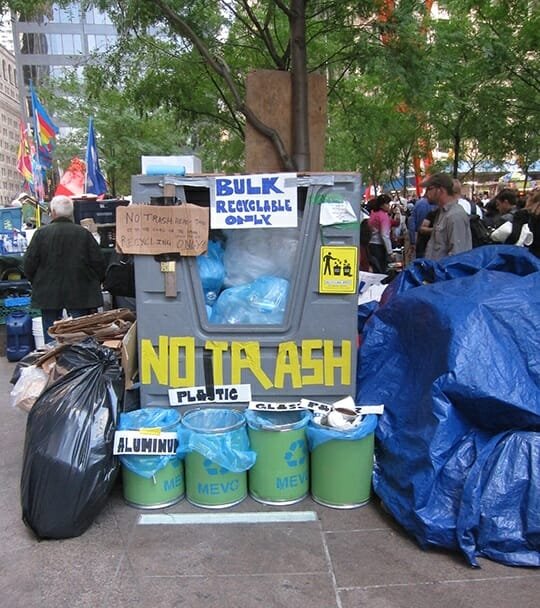
This movement is taking place in a surprisingly small plaza. Yes there are trees, but to call it a “park” doesn’t capture the setting. This is a cement enclave near Wall Street and The World Trade Center Memorial, the size of a city block minus much of the block taken up by wide sidewalks. They are operating at close quarters.
Bordered by Broadway, Trinity Place, Liberty Street and Cedar Street, this area was heavily damaged by the 9/11 attack. I would describe the actual “occupy” area as half of a football field in size. Yet it contains this rich mixture of people, ideas and purposes united around a rather simple yet profound banner, “We are the 99%.” Within this confine occupiers sleep, eat, discuss politics, organize and plan their systematic changes.
Beyond the basics described, I witnessed several serious working groups discussing a range issues.
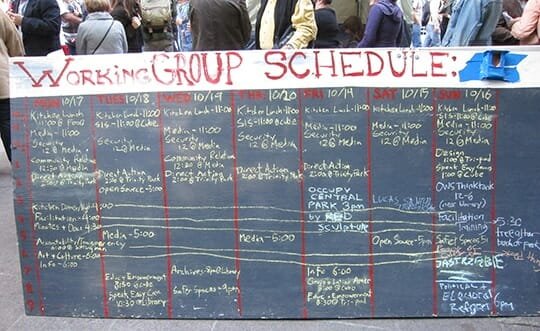
Inside the “Think Tank” a group was in the midst of debating a health care agenda.
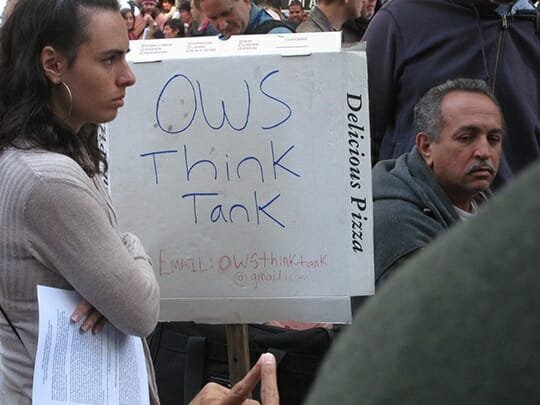
Think Tank
Toward the front (Broadway) of the plaza, a group of 20 or so were discussing women’s issues in the Zuccotti Park version of Robert’s Rules of Order with hand signals and the now familiar short sentence style repeated by others so everyone can hear. I listened for an hour or so to this highly functional collection of people.
Just maybe there is an awakening. Still relatively small but poised to grow. After 40 years of relative political dormancy, during which the 1% have garnered a whopping 40% of the wealth of this country as well as a stranglehold on our political process, perhaps there is a recognition that it is time to become attentive to public policy.
The chant, “What does Democracy look like?” and the reply, “This is what Democracy looks like!” might just make Jefferson smile…
“If once the people become inattentive to the public affairs, you and I, and Congress and Assemblies, Judges and Governors, shall all become wolves. It seems to be the law of our general nature, in spite of individual exceptions.”
Thomas Jefferson
Update 10/19
New poll out today, “Some 59 percent of adults either completely agree or mostly agree with the protesters.” As more people hear about the movement, the numbers go up. From the same poll…”Almost two-thirds of respondents—65 percent—said they’ve heard “a lot” or “some” about the rallies, while 35 percent have said they’ve heard or seen “not too much” or “nothing at all” about the demonstrations.”
Update two
Take time to read this article by Glenn Greenwald (previously a constitutional law and civil rights litigator in New York). He speaks of a climate of fear which extends to participating in political demonstrations. His blog is a great read.
Update three
From this expanding map of protest hot spots and reported arrests you can track the movement’s growth in the U.S. and worldwide. Click on the dots for details from more than 445 locations. Plus if you scroll down the site, there are several income inequality charts that graphically illustrate the problem.