by Mark | Nov 6, 2011 | All-Time Favorites, Deep In It
The Rock of Gibraltar. One minute you are driving in Spain and the next, passing through British customs.
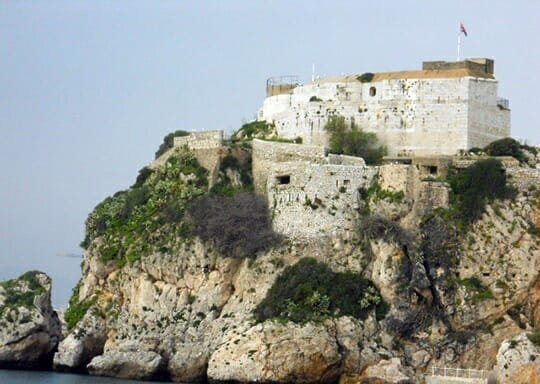
The history is long and storied, and territorial control remains an unsettled issue in Spain's view. The Rock stands 426 m (1,398 ft) high. Its upper area is covered by a nature reserve, home to around 300 Barbary apes. At the summit stands the Moorish Castle, built when Berber chieftain Tariq ibn Ziyad crossed from North Africa in 711 AD and established what would become 700 years of Moorish civilization on the Rock. Beneath the surface runs a system of underground passages — the Great Siege Tunnels — dug during a four-year siege that the Rock famously outlasted. This history inspired the saying: solid as the Rock of Gibraltar.
The Moorish Castle, built in 711 AD
Centuries of sieges, sovereignty battles, empires risen and fallen. We were there for the apes.
A colony of approximately 300 Barbary apes resides in caves near the top of the Rock. With dusk approaching, we drove at breakneck speeds to the summit along a narrow one-lane road built on a sheer cliff, with a mistake costing a 1,000-foot drop to the ocean. The view was breathtaking. The complaints about my driving were endless.
We spotted our first ape about two-thirds up the Rock.
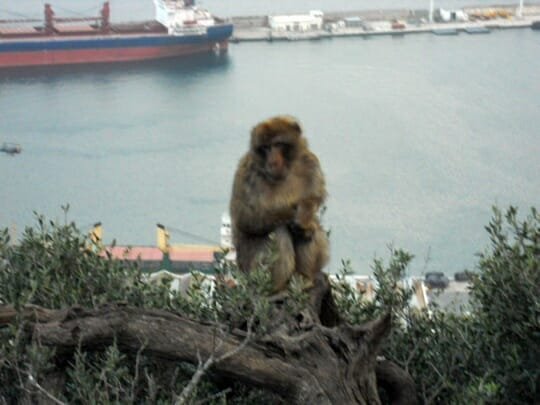
One of approximately 300 Barbary Apes on the Rock
Then they were everywhere. We pulled the car over against the rock's edge as tight as possible. Our daughter Stacy and I got out of the car and warily moved closer.
Unfortunately, I forgot to roll up my window. The car was parked tight against the sheer wall, making it impossible to exit from the passenger side. With unexpected speed and agility, one of the apes leaped to the window sill and leered at Betsy. She was trapped. As the ape peered in I had a brief moment to be the hero, grab the ape by the nape, and throw him to the ground. I balked. In my defense, don't be deceived by appearances — Barbary apes are known for their sharp teeth and bad temper.
Lots of screaming and yelling ensued, which fazed the ape not one iota. With fierce agility he leaped into the back seat to face Betsy. Breathing heavily with primordial lust, he seized the fruit salad bowl from her hands, gave a menacing look, and then left the way he came.

There he is — smug, fearless, and challenging me to do something.
It was later said that the photo is blurry because I was scared. I am writing this, so I find another explanation more appealing.
Stacy and I were laughing so hard we could have fallen off the Rock. Betsy was not laughing. She was recovering from her intimate encounter. He stole her fruit.
There was some talk afterward that I was not man enough to fight off the ape, that I failed to sacrifice myself to save my wife. What was I to do, shoo it away? In my defense, the ape sat on the window sill for maybe two seconds — sizing up his prey — before entering. Even so, my behavior was not exemplary. It's bad enough Betsy witnessed my less than manly performance — but Stacy was watching too.
We all escaped into the night retelling the story, with Stacy and I laughing and Betsy, disturbingly quiet. Eventually, I think all was forgiven.
Betsy has never confirmed this.
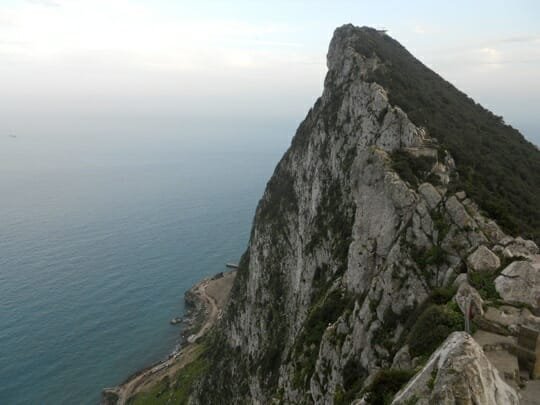
Majestic Rock of Gibraltar
by Mark | Nov 6, 2011 | All-Time Favorites, Pulled Back
Some days you leave the house for a seemingly normal outing and life confronts you with the profound and wonderful where you least expect it. That's what happened to us yesterday.
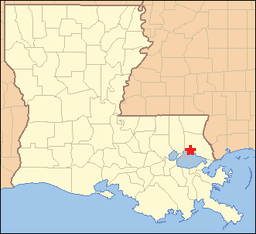
We left our temporary bayou home around 9:30 and drove to the pretty and historic town of Mandeville, Louisiana.
The town was laid out in 1834 by developer Bernard Xavier de Marigny de Mandeville. It soon became a popular summer destination for well-to-do New Orleanians wishing to escape the city's heat.
In the mid-19th century, regular daily steamboat traffic between New Orleans and Mandeville began. Bands played music on the ships crossing the lake. Mandeville became one of the first places where the new "jazz" music was heard outside of New Orleans. Bunk Johnson, Buddy Petit, Papa Celestin, George Lewis, Kid Ory, Edmond Hall, Chester Zardis, and many other early jazz artists regularly played here.
The Lake Pontchartrain Causeway — two parallel bridges crossing the lake — has been listed by Guinness World Records since 1969 as the longest continuous bridge over water in the world.
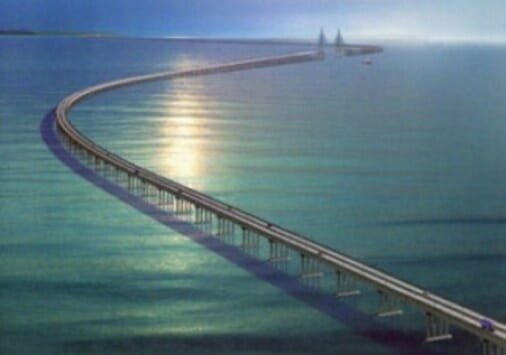
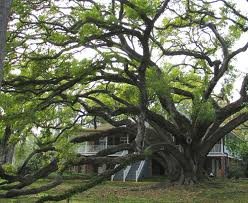 One more thing about Mandeville: the Seven Sisters Oak is the largest certified southern live oak in existence, estimated to be up to 1,500 years old, its trunk measuring 38 feet. It is the National Champion on the Register of Big Trees and the Champion Oak of Louisiana. The Seven Sisters survived a near direct hit from Hurricane Katrina in August 2005.
We had breakfast at Mande's in Mandeville. Eggs Sardou — poached eggs on English muffins with tomato, smothered in a spicy artichoke and creamed spinach Hollandaise sauce. If you can conceive of such a creation, you understand why we lingered.
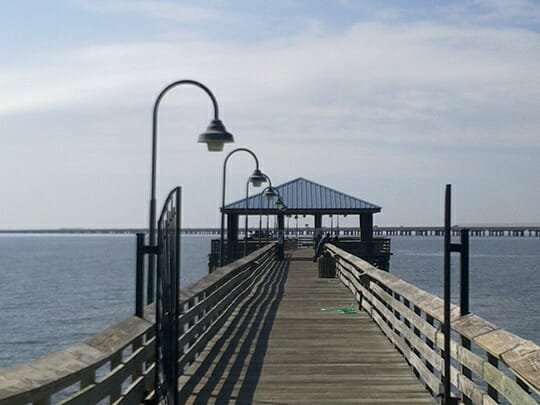
After breakfast we made our way to the lake and parked at a long pier with a majestic view. It was a clear, sunny day, around 70 degrees. The walk out on the pier was simply lovely.
We passed a handful of fishermen, remarking on the different birds, the warmth of the sun, the beauty of the lake. Then something stopped us. As we approached the end of the pier, a man casting a line turned and said we might not want to walk to the end.
We were speechless as he explained that a fellow fisherman had apparently died in his chair while fishing. During some general fisherman banter, the man had not responded, and it was then discovered he was not breathing.
The man died in this quiet, peaceful, beautiful setting doing what he loved. Trying to grasp how perfect his passing was, our thoughts gave way to the world around us.
Soon after, the EMTs and police arrived. There were questions — who was he, what about his family, when did he die, how long had he been fishing, was he alone. But none of that seemed to matter. It was perfect.
You hear people say they want to die this way or that. They imagine how their life will end, yet very few realize their moment. This man did.
We never made it to the end of the pier. It was enough. This ending was perfect.
by Mark | Oct 31, 2011 | All-Time Favorites, Pulled Back
On the next road from Washington, D.C., to New Orleans — leading through Montgomery, Alabama — we relived the history that had brought America a step closer to a more perfect union. A short stop, but an indelible one, in the birthplace of the Civil Rights Movement.
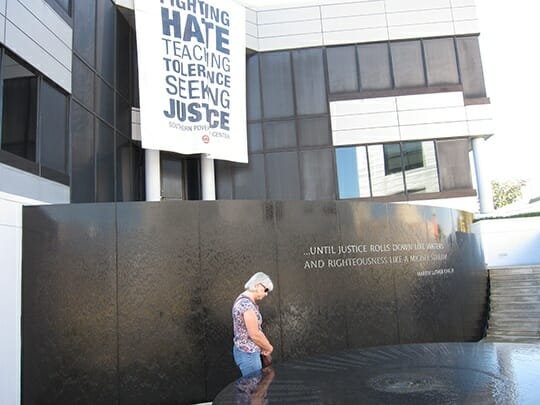
Civil Rights Memorial located at the Southern Poverty Law Center
We started at the Civil Rights Memorial at the Southern Poverty Law Center, within walking distance of many of the era's landmarks. The memorial was designed by Maya Lin, who also designed the Vietnam Veterans Memorial in Washington. She was 21 when her Vietnam Memorial entry was chosen from 1,421 submissions in a competition open to all Americans. At 28, she was asked to design this one.
The water-washed surface of the table is inscribed with the names of 40 people who died in the struggle for civil rights between 1955 and 1968, as well as landmark events of the period. The water motif was inspired by King's paraphrase of Amos 5:24: "We will not be satisfied until justice rolls down like waters and righteousness like a mighty stream." Inside the memorial, the displays tell the stories of those 40 and speak to injustices throughout the world.
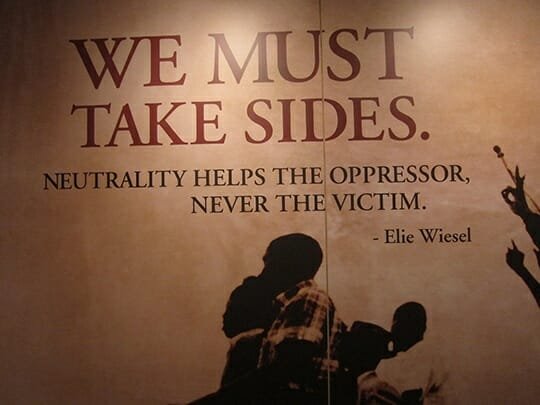
One of the 40:
March 25, 1965 · Selma Highway, Alabama
Viola Gregg Liuzzo, a housewife and mother from Detroit, drove alone to Alabama to help with the Selma march after seeing televised reports of the attack at the Edmund Pettus Bridge. She was driving marchers back to Selma from Montgomery when she was shot and killed by a Klansman in a passing car.
Viola's story runs deeper. Among the murderers in the car was an FBI informant, Gary Rowe, who was indicted in 1978 for his involvement in the killing. The first trial ended in a hung jury; the second in acquittal. The FBI under J. Edgar Hoover played a large role in attacking and undermining the Civil Rights Movement — and King in particular — as documented in the Final Report of the Select Committee to Study Governmental Operations. Some believe Hoover was instrumental in King's assassination.
The events of Bloody Sunday — the culmination of the three Selma to Montgomery marches — were broadcast on national television: the attack dogs, the beatings, the fire hoses. The violence was directed by Theophilus Eugene "Bull" Connor, who came to symbolize the murders, hangings, and sheer brutality brought to bear against those seeking basic civil liberties and social justice.
The national attention forced Americans to confront the legal and moral questions, culminating in the Civil Rights Act of 1964 and, a year later, the Voting Rights Act of 1965. Difficult as it is to accept: it took 100 years after the end of the Civil War to encode basic civil rights that had been denied to Black Americans across much of the South.
Leaving the memorial, we walked to Dexter Avenue Baptist Church, where Dr. Martin Luther King pastored from 1954 to 1960.
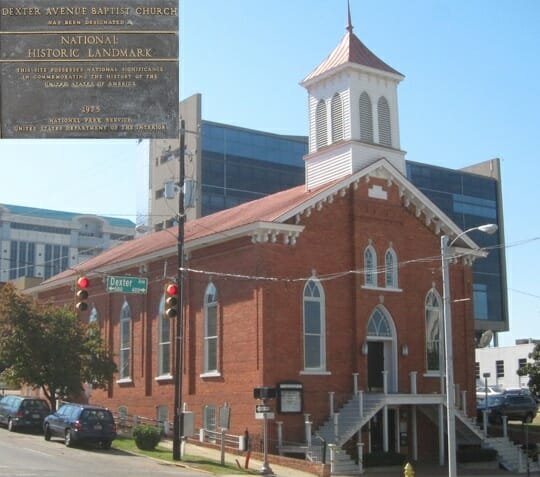
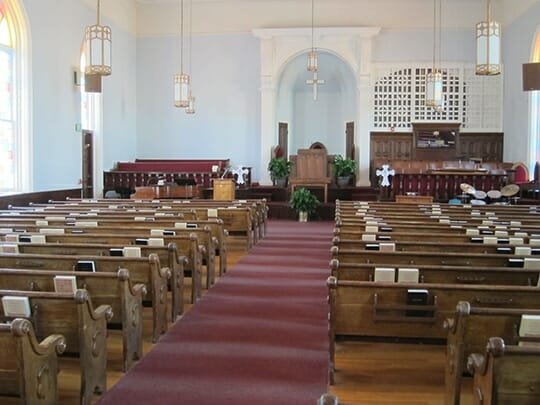
Many Black churches were burned and bombed during the movement — among them the 16th Street Baptist Church in Birmingham, where four girls were killed on September 15, 1963. Dexter Avenue was spared. The pews are handmade and date to the 19th century.
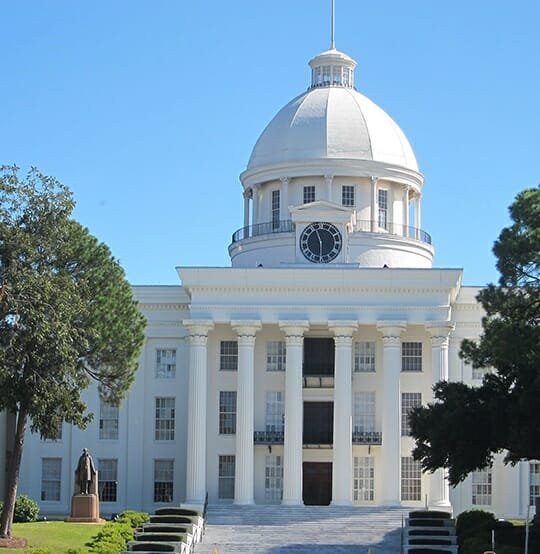
From King's office window, he had a direct view of the Alabama State Capitol, which had served as the first political capital of the Confederate States of America in 1861, before the seat moved to Richmond, Virginia. The Provisional Constitution of the Confederacy was drawn up there on February 4, 1861; the Permanent Constitution adopted on March 11. Over a hundred years later, the third Selma to Montgomery march ended on its front steps.
Montgomery also housed the first White House of the Confederacy, where Jefferson Davis resided as its newly elected president.
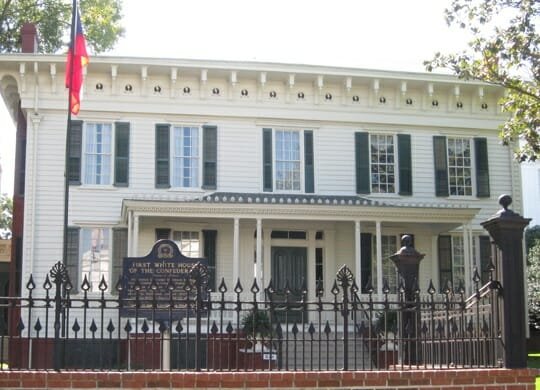
With time running short, we missed the Rosa Parks Museum — dedicated to the woman who refused to give up her seat, sparking the Montgomery Bus Boycott. Parks received the Presidential Medal of Freedom, the Congressional Gold Medal, and a posthumous statue in the Capitol's National Statuary Hall. At her death in 2005, she was granted the honor of lying in state at the Capitol Rotunda.
We left Montgomery too soon. Driving on the next road, we talked for hours about what we had seen and what any of us could do in the search for social justice. The work of the Southern Poverty Law Center — dedicated to fighting hate and bigotry and to seeking justice for the most vulnerable — is integral to that effort.
Farther down the next road, the conversation turned toward economic justice. It was 2011; the Occupy Wall Street movement was spreading across the country and around the world, pressing questions about poverty, health care, hunger, and gross inequality. It felt like the central moral question of the moment.
The march to a more perfect union never stops. But after walking through that history in Montgomery, the pace felt urgently, painfully slow.
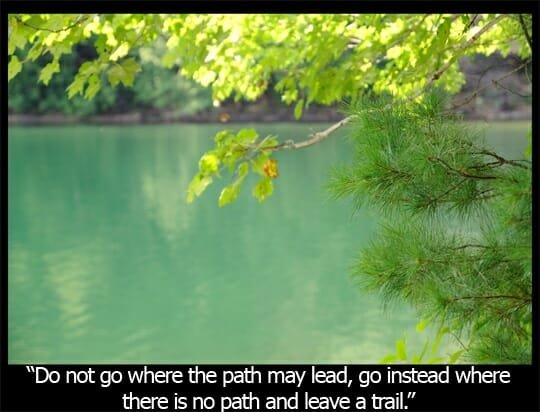
Photo of Walden Pond by Kelly (quote inserted)
by Mark | Oct 19, 2011 | Pulled Back
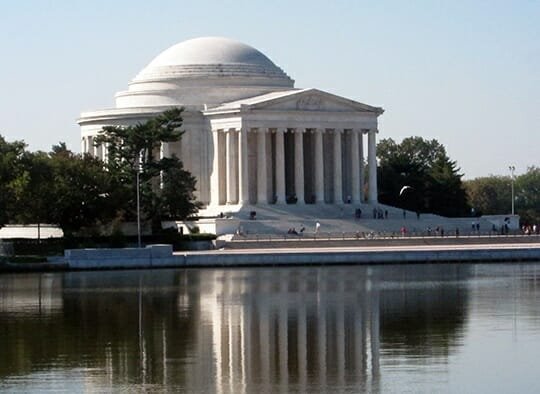
“The spirit of resistance to government is so valuable on certain occasions that I wish it to be always kept alive.”
Thomas Jefferson
Jefferson Memorial
It seems a spark has been lit spreading open rebellion against the greed and corruption in the corporate world and its control of the political process. The movement started in Zuccotti Park (formerly Liberty Plaza) and spread like a chain letter to over a 100 U.S. cities and worldwide. Early on the movement was met with skepticism and “dirty hippie” epitaphs but now garners over 52 percent approval from those following the story closely. In New York City that number approaches two-thirds. Given the shoddy corporate media coverage, as more people begin to follow this story closely, these numbers are sure to grow.
We might have a movement, or as Jefferson suggested an attention to public affairs. Having spent a few days here in Washington D.C. attending October 2011 and Occupy DC, a bus trip to New York City to get a first-hand view of the birth of the movement seemed important.
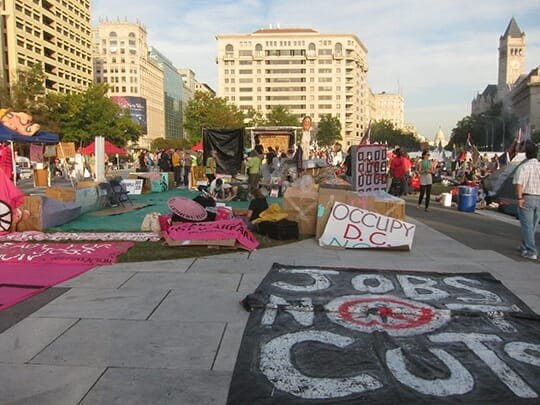
Freedom Plaza, Washington D.C.
Watching the distorted news coverage of Occupy Wall Street that seemed to purposefully paint a negative image of the occupy movement, I was surprised by the size of the location and scope of activity.
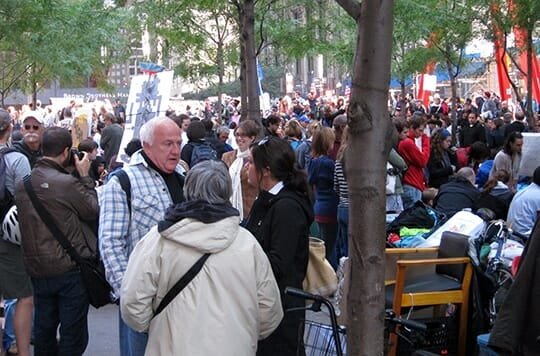
Liberty Plaza aka Zuccotti Park
What I saw in Zuccotti Park was much different than what the mainstream media portrayed and 180 degrees from right-wing Fox News coverage. If I were part of the 1% rather than the 99%, I would be mildly concerned. While barely a month in the making, these people have entrenched impressive organizational strides. They are discussing serious issues searching for a consensus that can jell into a platform for radical change in our politics and society. These people are for real.
Some of the impressive infrastructures I noticed were basic but well implemented like a kitchen and pantry…
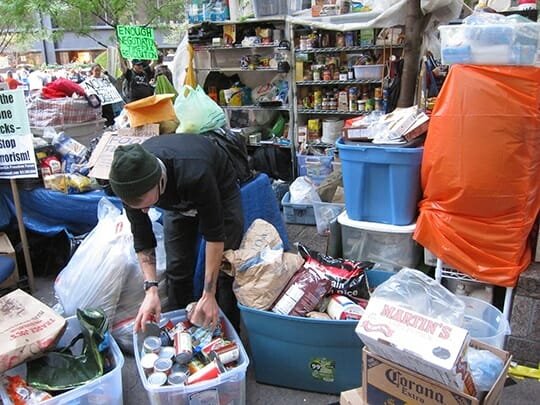
Food Pantry
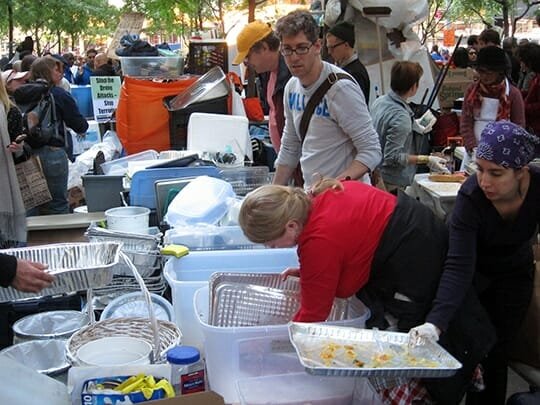
Kitchen
A well stocked “People’s Library” started by Betsy Fagin, a graduate of Vassar and Brooklyn College.
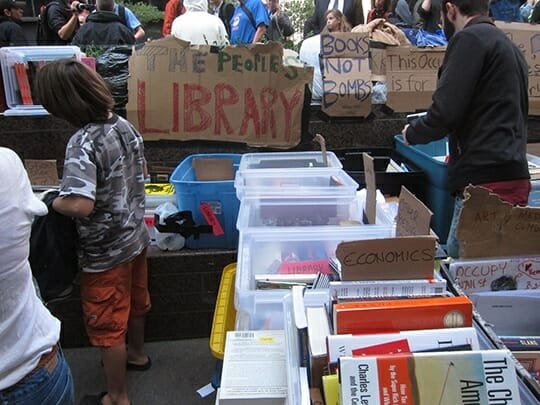
People’s Library
Basic necessities in this area called “Comfort Station” including hats, mittens, sweaters and boots seem to be stockpiled, portending a protracted stay.
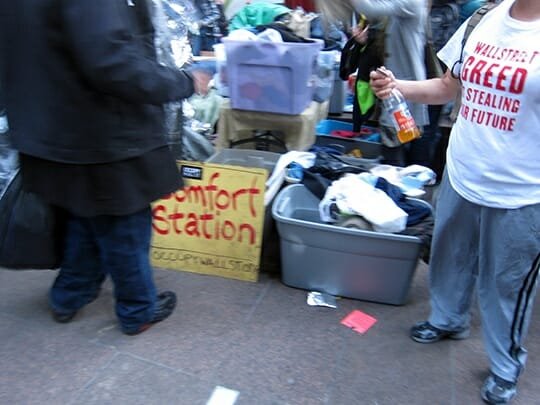
Comfort Station
Does this level of sophistication look like the work of “dirty hippies,” or committed activists seeking what Jefferson called a “spirit of resistance?”
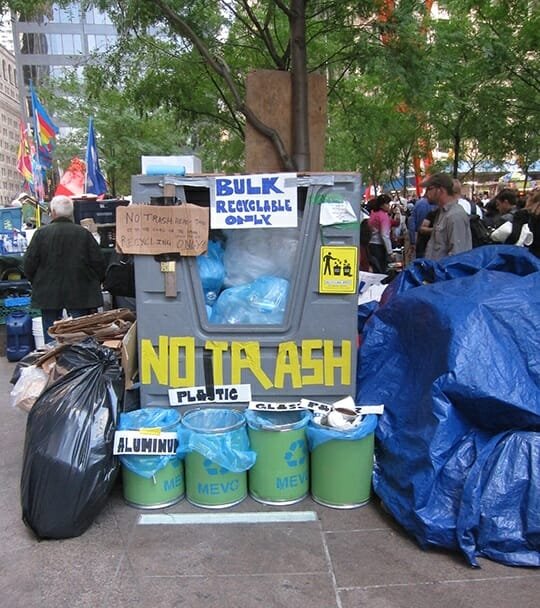
This movement is taking place in a surprisingly small plaza. Yes there are trees, but to call it a “park” doesn’t capture the setting. This is a cement enclave near Wall Street and The World Trade Center Memorial, the size of a city block minus much of the block taken up by wide sidewalks. They are operating at close quarters.
Bordered by Broadway, Trinity Place, Liberty Street and Cedar Street, this area was heavily damaged by the 9/11 attack. I would describe the actual “occupy” area as half of a football field in size. Yet it contains this rich mixture of people, ideas and purposes united around a rather simple yet profound banner, “We are the 99%.” Within this confine occupiers sleep, eat, discuss politics, organize and plan their systematic changes.
Beyond the basics described, I witnessed several serious working groups discussing a range issues.
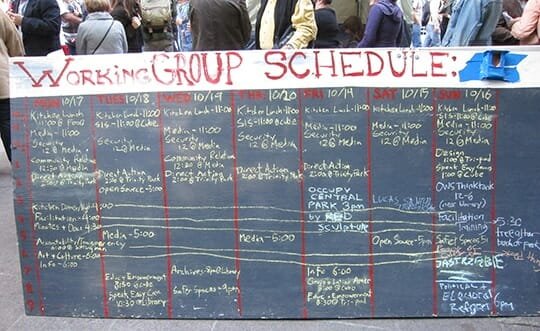
Inside the “Think Tank” a group was in the midst of debating a health care agenda.
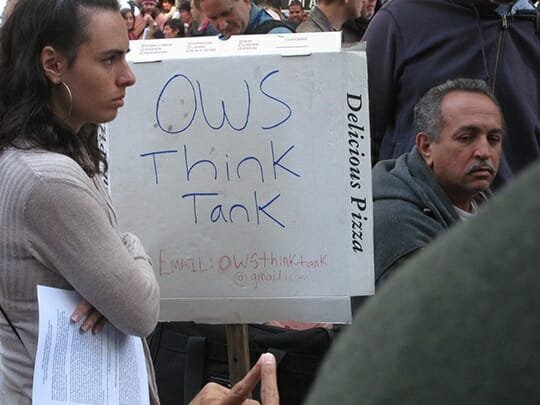
Think Tank
Toward the front (Broadway) of the plaza, a group of 20 or so were discussing women’s issues in the Zuccotti Park version of Robert’s Rules of Order with hand signals and the now familiar short sentence style repeated by others so everyone can hear. I listened for an hour or so to this highly functional collection of people.
Just maybe there is an awakening. Still relatively small but poised to grow. After 40 years of relative political dormancy, during which the 1% have garnered a whopping 40% of the wealth of this country as well as a stranglehold on our political process, perhaps there is a recognition that it is time to become attentive to public policy.
The chant, “What does Democracy look like?” and the reply, “This is what Democracy looks like!” might just make Jefferson smile…
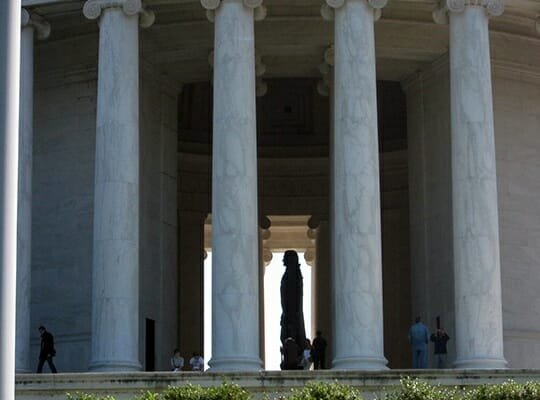
“If once the people become inattentive to the public affairs, you and I, and Congress and Assemblies, Judges and Governors, shall all become wolves. It seems to be the law of our general nature, in spite of individual exceptions.”
Thomas Jefferson
Update 10/19
New poll out today, “Some 59 percent of adults either completely agree or mostly agree with the protesters.” As more people hear about the movement, the numbers go up. From the same poll…”Almost two-thirds of respondents—65 percent—said they’ve heard “a lot” or “some” about the rallies, while 35 percent have said they’ve heard or seen “not too much” or “nothing at all” about the demonstrations.”
Update two
Take time to read this article by Glenn Greenwald (previously a constitutional law and civil rights litigator in New York). He speaks of a climate of fear which extends to participating in political demonstrations. His blog is a great read.
Update three
From this expanding map of protest hot spots and reported arrests you can track the movement’s growth in the U.S. and worldwide. Click on the dots for details from more than 445 locations. Plus if you scroll down the site, there are several income inequality charts that graphically illustrate the problem.
by Mark | Oct 3, 2011 | Deep In It
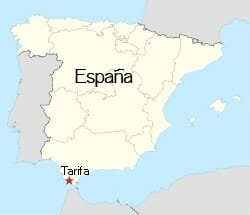
Tarifa offers a historical and beautiful setting with Morocco a short 10km across the Strait of Gibraltar, a gateway between the Atlantic and the Mediterranean. Beaches, natural beauty, climate, and location combine to make Tarifa worth seeking out.
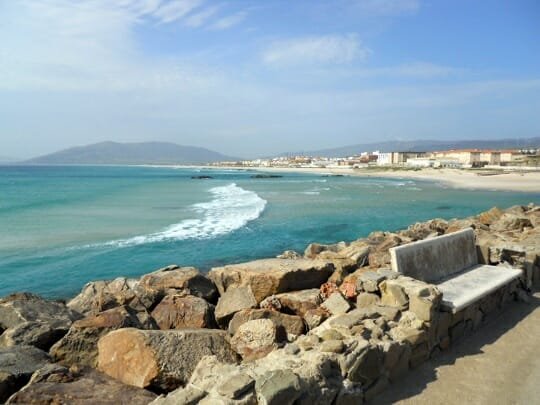
The wind here is legendary. This is a mecca for all wind-related water sports attracting the best from around the world. While steeped in a long history, it has the feel of a California beach town but more international. The city is relatively small (20,000). We caught a picture-perfect day with the wind blowing in all its glory.
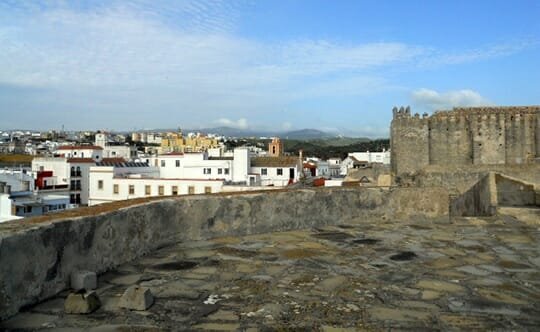
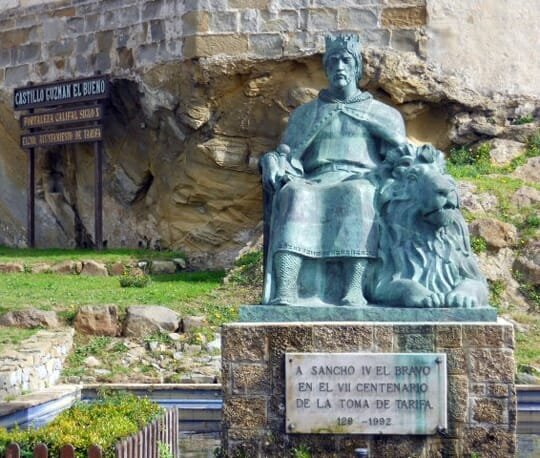
The best view of Tarifa can be had from the battlements of Castillo Guzmán el Bueno (castle of Guzman the good) who earned his moniker by refusing to hand over the castle in 1296 to the besieging forces of the Infante, Don Juan, and the Moors in exchange for the life of his son (good story).
A statue of the hero stands in front of the castle:
Tarifa has a hippy element which may account for the nice selection of vegetarian restaurants. We ate at a combination yoga center and restaurant called Tarifa EcoCenter and met an interesting German woman who came to Tarifa to visit her boyfriend and stayed. The city has that kind of appeal.
Beyond the natural beauty and wonderful climate, Tarifa offers the annual African Film Festival, dedicated to African cinema.
For the naturalist, Tarifa serves as a key point of passage for migrating birds between Africa and Europe. For birdwatchers one of the most impressive sights over the Straits is when flocks of storks, sometimes numbering up to three thousand, cross en mass relying on thermals and updrafts which occur over narrower expanses of water.
It was tempting to take the shuttle to Africa...
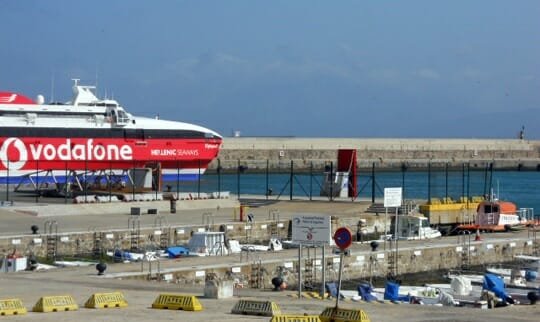
but with reservations in Malaga, we headed East along the Costa del Sol to arrive by nightfall.