Slow Travel Finds Sardines on the Beach in Crucita

Slow Travel Finds Sardines on the Beach in Crucita

It was early October, another beautiful morning at our tranquil Ecuadorian beach house. But our view of the consistently blue Pacific had changed. Large barcos lined the horizon while small fishing boats dashed out, docked and then returned, overloaded with mounds of shiny sardines. We had been warned that our "California beach of the 1950's" would become a commercial fish cleaning zone but, it happened fast and was complete and we were shocked.

During our three month slow travel in Ecuador, we rented a beach house in Crucita for five weeks. It wasn't long before we discovered ourselves center stage in an intense local dispute that pits the sardine industry against local advocates fighting against the practice of using chop and clean houses on the beach. Currently the beach shacks serve as pre-packaging plants for the giant canneries in Manta across the bay.

Crucita has a beautiful shallow bay. During the 10 months of sardine fishing, the large fishing boats (barcos) that follow the Humboldt current just off the coast of Ecuador for the rich river of sardines use the bay for safety and to station themselves. We counted up to 14 one day.
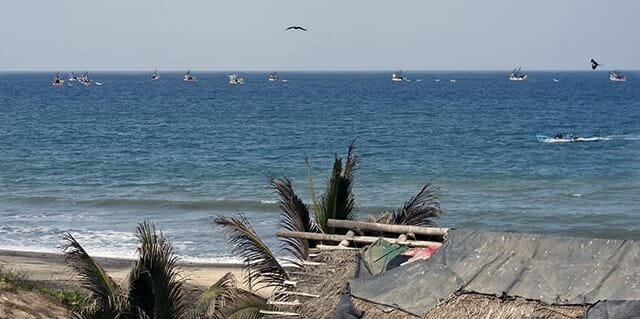
Slow travel discovers large fishing barcos off shore

The sardines are fished at night; it's best when moonlight exposes the shallow-swimming, silvery schools to the fishing boats and eventually the nets. Given the bonanza of nutritionally rich food like sardines, the Humboldt also teems with larger fish. So for example, Manta, Ecuador, the lights of which can be seen at night across the bay, is the tuna capital of the world.

It gets a little complicated and there are several subplots, but the fight we found revolves around a historical and supposedly illegal practice of cleaning and chopping the sardines on the beach. At daylight the locally owned small boats go out to the large barcos, where the sardines are collected from the fishing barcos and brought to shore for cleaning.
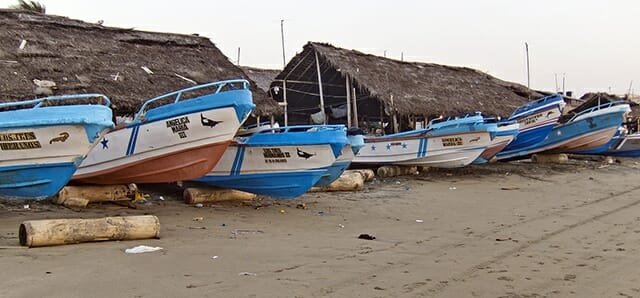
Small fishing boats line the beach of Crucita

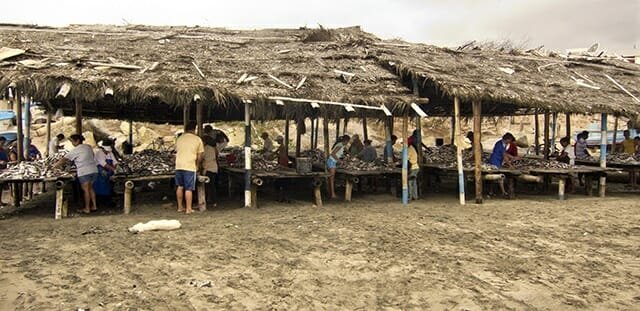
Crucita is one of  the last fishing village that allows the chop shacks on the beach. The open air, thatched roofed, wooden pole shacks are roughly 40 feet long and 30 feet wide. Inside there are several tables, each about five feet wide with wood planks running  the 30-foot width. The fish are cleaned and chopped on the planks. So each shack can have dozens of people working on both sides of the tables. One of those chop shacks was in front of our house.

Slow travel eventually revealed chop shacks on the beach of Crucita

Since this is one of the last communities to allow the chop shacks, sardines are also trucked (small to mid-sized trucks) from nearby fishing villages to Crucita and then brought on the beach to these cleaning sheds (30-40 of them).

Then the cleaned sardines are trucked to the major canneries in Manta about 40 miles away. Huge facilities there include U.S. companies like Bumblebee and Chicken of the Sea, although those two process tuna, while other canneries specialize in the sardines.

The fight to get this practice stopped in Crucita has escalated. The local government  council allows it to continue and of course the canneries benefit because they receive cheaply cleaned sardines. You can imagine the resistance in place to any change. The chop and clean shacks are a cash business. Perhaps that helps explain why they remain.

Here is one of the nuances: the locals on the beach aren't paid the wages they would if they were in a processing plant, not to mention the "social security" they are legally entitled to, and they work in rough conditions. At high tide the chop and clean crews stand in water. Plus children are working. Add to that the unsanitary conditions and lack of refrigeration, and the nutritionally rich sardines we buy don't sound that appetizing.
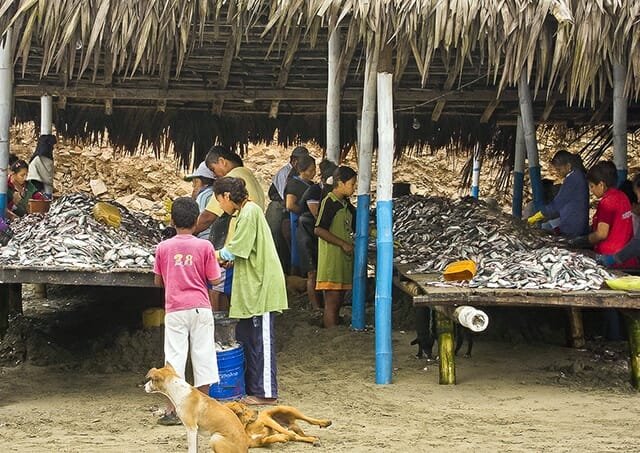
Sardines piled high in chop shacks, dogs playing, kids cleaning sardines

The locals working against the chop shops believe the practice is illegal under Ecuadorian law and that the child labor has to end. Their efforts to end the beach practice has created pressure that affects many interests.

The advocates believe most of the workers are on their side since they would benefit from moving the cleaning and chopping off the beach to legitimate sites where they would be paid more and have better working conditions. But there is also a strict hierarchy among the sardine crews which tightly regulates the status quo.
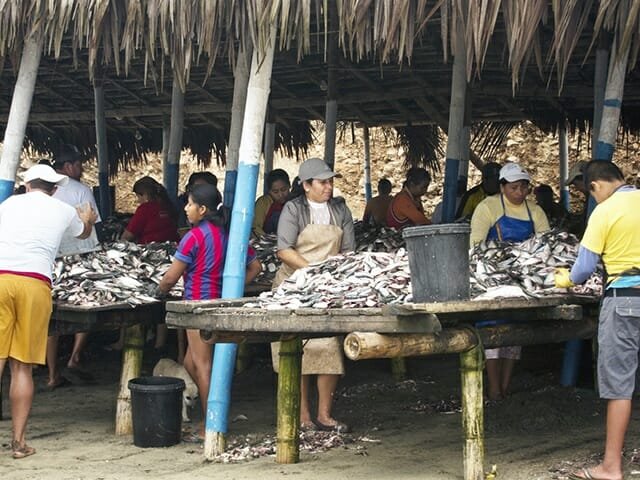
Another picture of locals working in the chop shacks

Shortly after the season resumed in October, we saw the beach transformed into a bloody mess of fish guts and blood flowing to the ocean and truck oil stains on the beach. It seems as though there are legal, ethical and environmental issues at stake. The chop and clean shacks have been documented extensively, but they remain in active operation.

It is not known if President Correa is aware of the beach pre-processing shacks or the issues involved. The advocates were working hard to get their message out to local and regional officials and to the newspapers under the assumption that shining the light on this practice on a beautiful Ecuadorian beach would force public outrage and change.
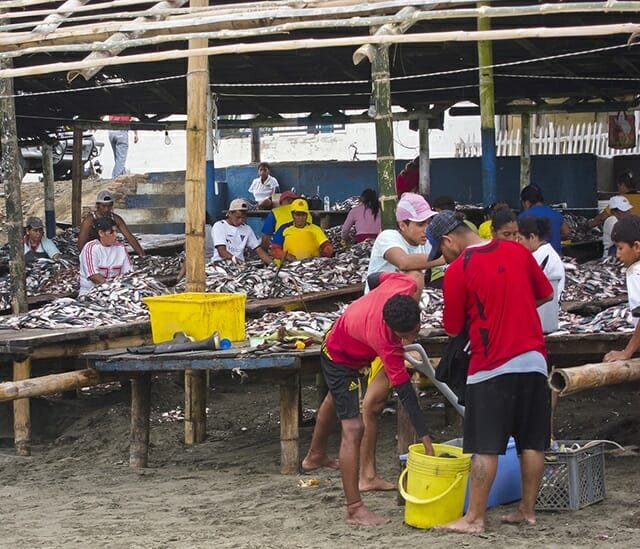
Amazing picture of sardines piled high on wooden tables under the chop shacks with locals cleaning

Ecuador is changing fast. President Correa is very popular (60-70% approval rate) and seemingly doing an amazing job while fighting entrenched interests. He is up against the local councils, many of which are powerful, so new laws  can get choked before they breathe. The lack of action here may be a case of choosing one's battles.

Ecuador's development, particularly in the last five years, is amazing to see; roads are being built everywhere, mandatory schooling has been implemented along with child labor laws, a minimum wage, and "social security." Before Correa, Ecuador changed governments so often there was no stability. Now the country is swept up in massive social, political and economic changes. By the way, Correa is U.S.-educated with a PhD in economics.

I know what you are thinking, and there is an organization that is responsible for fishing regulations, it is called CEIPA. And seemingly they are aware of the chops shacks on the beach or at least should be after this article. Yet the shacks remain on the beach.

One more quick beach practice that caused a stir. During my runs on the beach I passed this truck a few times watching three or four guys vigorously loading it with sand and then I would watch it drive down the beach towards town. I was told they were using or selling the sand for mixing concrete for the local construction projects.
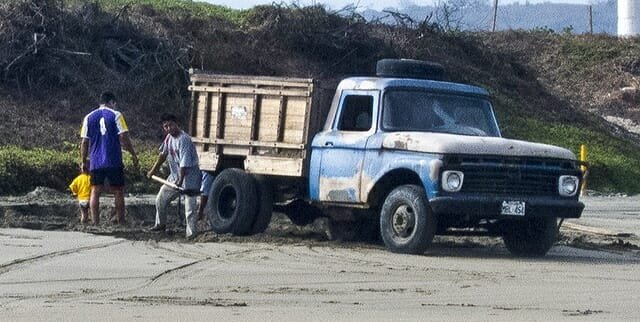
Locals shoveling beach sand in truck for construction project

Suffice it to say we enjoyed an interesting slow travel experience in Crucita. This story unfolded in bits and pieces over our five week stay as we got to know the advocates. While intriguing, the atmosphere was too inflamed to feel comfortable and the beach was a mess. Our time in Crucita was over,  we moved on to Cuenca.
Slow Travel #59, A Birthday to Remember

Slow Travel #59, A Birthday to Remember

#59-#17, Unforgettable numbers…

On November 17, 2012, I turned 59. It was a beautiful morning during our slow travel experience in Cuenca, Ecuador, and the plan was a low-key celebration. We had a simple breakfast, then around 10 we took the 25-cent bus ride to el Centro. The city was bustling as we walked through the flower market, along the cathedral and down to the Riobamba River.

Brightly dressed Cuenca woman selling fruits on the sidewalkWe made our way to the Broken Bridge, the location of a gringo event put on by the Chamber of Commerce where we enjoyed the music, bought some snack foods and sat by the river.

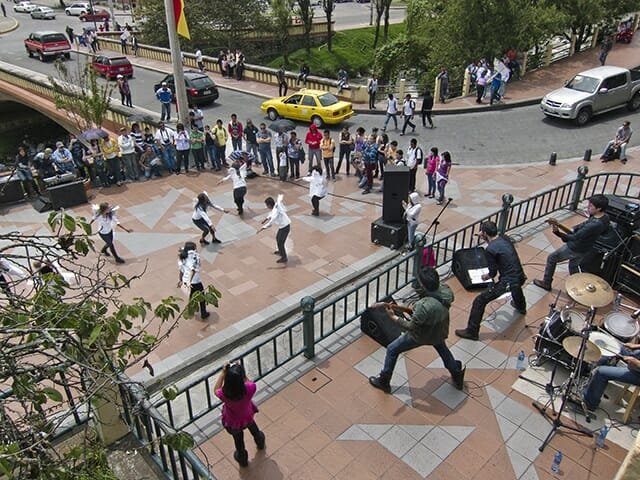
Music and dancing in square in CuencaIt was a decision point, between a movie and dinner at Joe’s Secret Garden (rated #1) in Cuenca or taking a bus excursion to el Agave, a Mexican restaurant located about 30 km south of town that we had learned about in Spanish class.

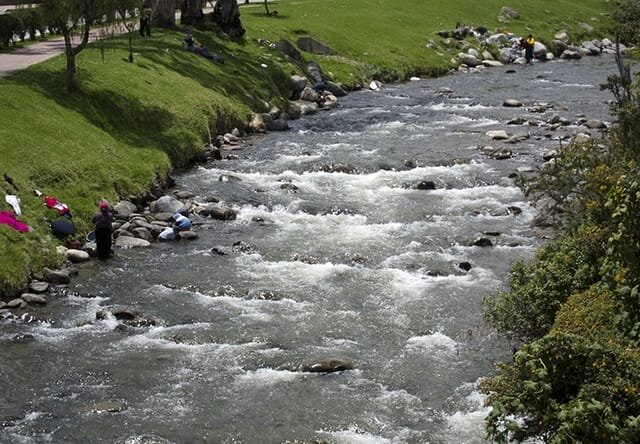
Beautiful mountain river through Cuenca with women washing clothes

Comida de Mexicana won out so we hailed a cab to the always busy Terminal Terreste (bus station). We were looking for the Giron or Yunquilla or Tarqui bus, all of which headed south on the Pan American highway. According to our Spanish teacher one of those would take us to mile marker #17 and el Agave. We exited the terminal, dropped 10 cents in the turnstile and walked among the 30 or so buses searching the outgoing ones. The Giron bus was obscure but we found it.

The man handling the ticketing was at the bus door where we got into the discussion of mile marker #17, trying  to establish that we wanted to be dropped off there. Our Spanish failed us (milla diecisiete?), we tried everything including drawing a picture of a sign with a #17 on it. Nothing. All three of us grew frustrated, but we decided to get on the bus anyway because we were pretty certain it was going in the right direction.

We knew the restaurant was near Tarqui, a small village south of Cuenca. As we sensed we were getting close to Tarqui, the ticket guy came up to us and said in rather clear Spanish for us to get off at the next stop. We weren’t sure we were in Tarqui or that we should be getting off but hoped our Spanish would be understood by someone else. We paid our $3 as we slipped off the bus.

We asked at the outdoor restaurant near the bus stop, and the woman seemed to recognize comida de Mexicana and pointed up the road. A young man in his 20’s whom we guessed to be the woman’s son was working hard to strike up a conversation with us. The scene on this Saturday afternoon was getting confusing. Our Spanish wasn’t working. As I worked my best Spanish on the woman, I turned around to find the son had encouraged Betsy for a dance. The radio blared and the small crowd was clapping and enjoying the activity. It was time to move on. We did discover that the village across the road was Tarqui so we felt we were close; still no one seemed to know about the mile markers (signo?). We started walking.

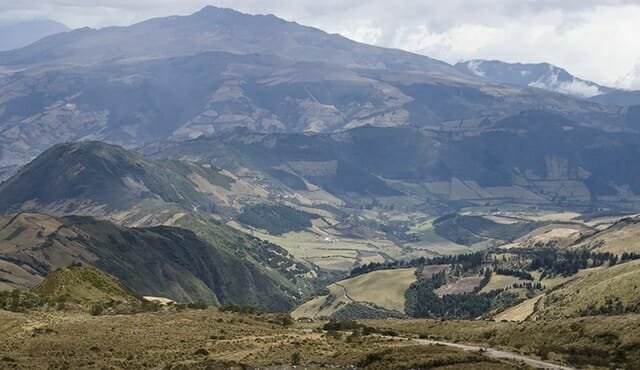
Beautiful scenery while slow travel along Highway of the Americas outside Cuenca EcuadorIt wasn’t long before we decided to get on the next bus and flagged it down. We experienced similar  translation issues for the next couple of kilometers (mile marker is a tough translation), although this guy seemed to know about the restaurant. He was turning at the next intersection but directed us to get off the bus and go straight, also pointing up the road. So we got off and started to walk again. Soon enough we discovered a mile marker #15 stake as plain as day. Unbelievable. Then we noticed that on the curb the location was painted in 20-meter increments, e.g. 15-200, 15-220, etc. When we found the stake for mile marker #16, our confidence soared. And we kept walking.

Walking along the side of the busy highway was problematic but the scenery was beautiful. The views of cow and crop-dotted  fields  against the wall of mountains were as idyllic and beautiful as they come. Near marker 16-380 we stopped at a small store and asked. The woman knew immediately when Betsy said comida de Mexicana. She pointed farther up the road toward mile marker #17. Our pace quickened and soon enough, hungry from our efforts, we arrived at el Agave, mile marker #17-420.

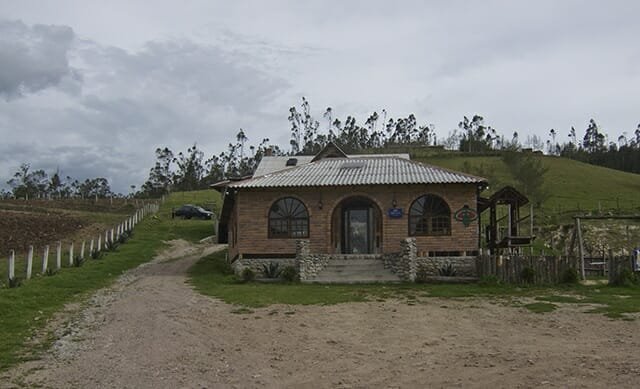
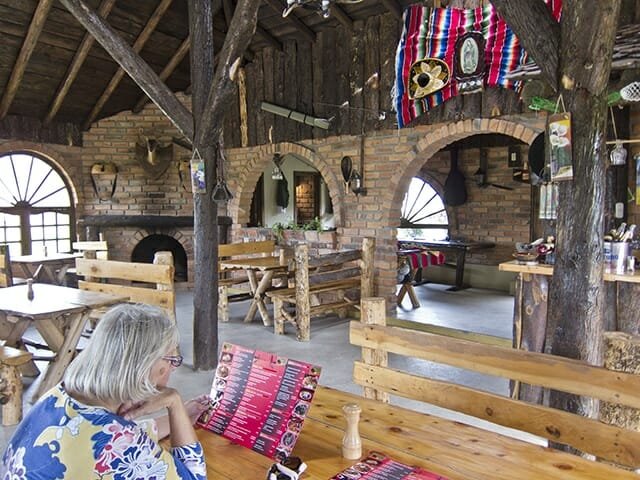
After three months of slow travel in Ecuador, we at my 59th birthday dinner at this Mexican restaurant outside CuencaWe walked into the homey, rustic restaurant and sat down at one of the large wood tables. It was time for a cerveza and our first Mexican meal in a long time. The time was 4 p.m. It had cost $4.50 in bus fare and taken us four hours to go 30 km.

Inside of Mexican restaurant. Nice, simple decorations with simple wooden tablesMy 59th birthday meal was minutes away. The owner’s young daughter approached the table and spoke in perfect English with a bright smile and sunny demeanor. We discovered she was in 11th grade and found the math in her Ecuadorian school more difficult than her previous school in New York State. The family had moved about four years ago, and while she missed her friends, she liked living in Ecuador. She took our order of fajitas and a taco plate.

During the meal, the mother and father came to our table and we chatted about life in the U.S. and their new life together in Ecuador. He was Ecuadorian and she was Mexican. They liked their simple lifestyle and proudly talked about the new home they were building behind the restaurant. There were cows and a horse in their field next to the restaurant and chickens in the yard. Their garden was ready to be planted. They seemed content. It was a perfect meal.

When it was time to leave, we asked about another member of their family who we had heard made amazing cheese, cheese products and cheesecake. They directed us up the hill, so we walked and found their small store. It was simple inside with displays of cheeses and yogurts and cakes. We  exchanged small talk but our mission was two slices of birthday cheesecake.

We started to walk back down the hill looking to flag down the next bus headed back to Cuenca. At the #17-220 marker an older jeep-styled truck pulled off to the side. We approached and the man introduced himself as Leo, a member of the restaurant family. Somehow our story of walking so far for dinner had reached him from the restaurant. He offered to give us a ride to the next bus stop. Slightly skeptical since we hadn’t met him in the restaurant, we got in, squeezing together on the front bucket seat. Leo spoke good English, he also had lived in New York State where he worked construction, bought and restored houses, and at one point during the housing boom had a crew working for him. He spoke of his wife and 13-year old son still living in the U.S. We would later find out that Leo had been deported.

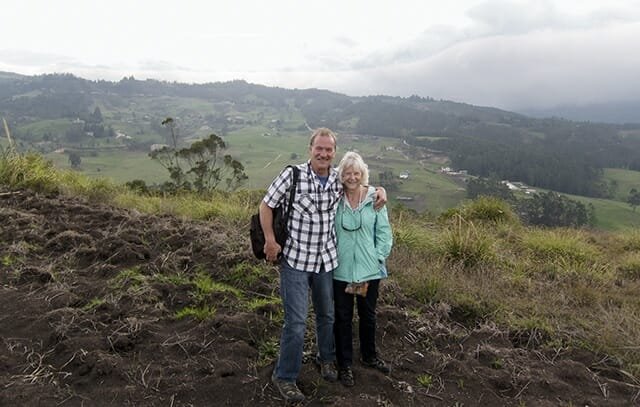
Betsy and Mark high in the mountainsWe weren’t far down the road when Leo asked if we would like to take a ride into the mountains. Pausing a second to consider if going up in the mountains in our new acquaintance’s beat-up Jeep was sane, the next birthday adventure opportunity seized the moment. For the next hour Leo crept up the steep mountain along two-track dirt roads through several small villages. There were beautiful vistas of the valley as we neared the highest point of the surrounding mountains. At one point we were looking down on an approaching cloud bank. The elevation in the area was higher than Cuenca (8400 feet) and after our climb, Leo estimated we were at about 11,000 feet. As we drove along Leo would honk or wave at the people he knew which seemed to be about everyone. We eventually came to a small farmhouse that Leo’s dad owned and had been in the family for decades. They grew some corn and fava beans on the property. His father, now in his 80’s, had moved some time ago. Leo asked if we would like to see it but by now darkness was approaching and we passed. Leo said, “Next time.”

As Leo worked his way back down the mountain to the highway, we continued the conversation; then to our surprise he offered to drive us to Cuenca. He said he enjoyed the conversation and appreciated the opportunity to practice his English. Our conversation ranged from the community’s fight against an expanding Canadian gold mine in the next valley that they feared would contaminate the river and water supply to the contrast between living in the U.S. and Ecuador.

Leo said he owned 80 dairy cows and also worked odd construction jobs. There were many large, mountainside homes owned mostly by U.S. expats who provided some work for him.

He went on to tell us that about four years ago at the height of his business in the U.S. he was stopped by the state police l in New York and asked to prove his citizenship. He said that he had paid an attorney $10,000 to become a legal resident but that the attorney had basically stolen the money. Lacking papers, he was taken into custody and shortly thereafter deported. He said he was not bitter but that perhaps the state trooper had gone further than necessary and lacked the jurisdiction to ask him to prove his citizenship. You could tell that being forced to leave his family and business hurt him immeasurably.

We talked about the contrast between lifestyles, how families in the U.S. are increasingly pulled apart by economic issues but also the normal path of life there. In Ecuador most families still lived in close proximity. The discussion moved to the race to get ahead in the U.S., to make money, and at times devoting more of one’s life to work than to family. The pace was much slower and the striving less intense in Ecuador.

We thought of our own circumstances, how our family has dispersed, how we are connected electronically with Skype and email but go months without seeing each other. Interesting stuff to ponder.

It was dark now as we re-entered Cuenca. Perhaps my over-cautiousness led us to have Leo drop us off at the Super Maxi grocery store a few blocks from our apartment. I was thinking we should invite Leo to our apartment, have a birthday drink, and continue the conversation. That thought will linger. I still consider what causes us to be skeptical and cautious and why other cultures are more open. We said our goodbyes and Leo told us that if we get back to Ecuador be sure to visit.

My 59th birthday will be remembered — it had a pace, slow at first then a faster tempo of presents, if you will, of challenges, new experiences, and interesting people. How could I forget mile marker #17, another interesting local bus experience, walking far along the Pan American Highway, and Leo’s unexpected Jeep ride through mountain villages. Not to mention delicious Mexican food in Ecuador and sharing part of the day with a complete stranger. At the end, life moves on toward #60 and what that will bring…

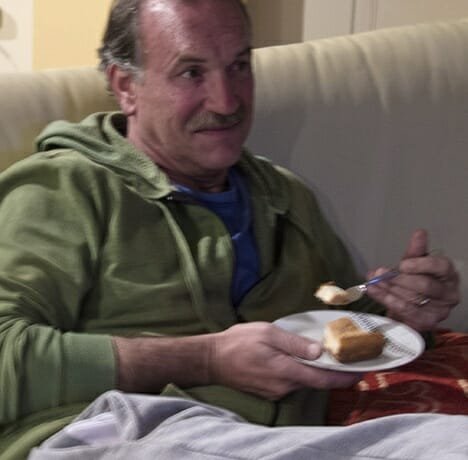
Mark enjoying birthday cheese cake at the end of the day

By the way, after a little research it seems as though marcador de milla is the closest translation for mile marker; another is kilometraje diecisiete. Suggestions are welcome.