Settling into to Granada, Spain

Settling into to Granada, Spain

3/25/2010

“How lazily the sun goes down in Granada, it hides beneath the water, it conceals in the Alhambra!”
Ernest Hemingway, American novelist.

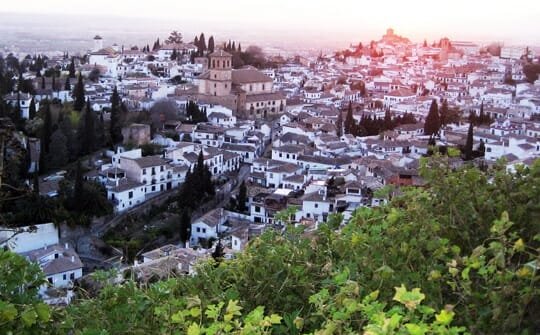
High above Granada in Sacromonte

There would be much to see and do in this historic and beautiful city in the coming weeks. But now I share one of my favorite quotes about Granada, “Give him charity, girl, as there is nothing worse in life than being blind in Granada.”  — poet Francisco Alarcón.

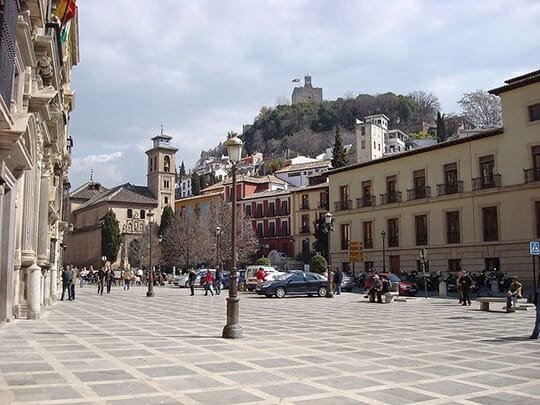
Our first order of business in Granada was to secure a room at Hostal Zurista in Plaza Trinidad, then park the rental car and begin exploring. This beautiful city was to be our home for the next month.

The rest of the day was a combination of sightseeing and apartment hunting. The next week would kick off Semana Santa, one of the largest celebrations in Spain. Granada’s Semana Santa is a huge tourist draw and made our search for the perfect apartment more difficult given the influx of tourists from around the world to witness the amazing celebration to come.

That evening while walking the wondrous narrow streets we wandered into a real estate company, chatted with the owner, a man of 70 (setenta años) who lived in Granada his entire life. The conversation was difficult at best due to our lack of Spanish, but we were able to schedule a meeting for 10 a.m. the next morning to look at a couple of apartments.

Quite the gentleman, Esteban was dressed in a suit with a fedora when we met promptly at 10; he removed his fedora and greeted us with a cordial buenos días.

Stacy and Esteban were able to have a conversation as we walked about a mile under beautiful sunny skies along narrow cobblestone streets (calles). The weather was perfect with a temperature of about 21 degrees celsius (70 degrees) and people were out in throngs enjoying it. Our first full day in Granada.

Our language challenge became more noticeable here, in that the Spanish spoken is very fast with a heavy accent; it is muy deficil (very difficult) to understand. We constantly say, hable más despacio por favor (speak more slowly please) so we can try to understand.

We looked at two apartments, one was very nice, great location and modern, the drawback was that it had only one bedroom (dormitorio) and a futon in another room which was less than ideal. The second apartment was less modern and still had the same one bedroom problem. After walking a mile or so, and then a few blocks to the second apartment, we walked up about four flights of narrow stairs. Esteban was winded but not terribly so. Not many at 70 that I know, and some much younger, could have made that walk and climbed those stairs and have the same said. A lifetime of walking.

On the way back to Plaza Trinidad, we passed the local market which has 40-50 stalls selling meats, fruits and vegetables. Esteban seemed to know everyone. When we reached our hostal, Esteban gave us his card and then left without pressuring us.

We regrouped, ate some lunch and then set out to a second real estate company (imobiliária).  We rented the first apartment they showed us in a great location, spacious, with two bedrooms. We were a bit hesitant to sign a contract for the apartment written in Spanish, but luckily the agent knew about Google Translate and was able to print it out in English. We managed this feat with all of our language skills stretched to the maximum, finalizing with great relief.
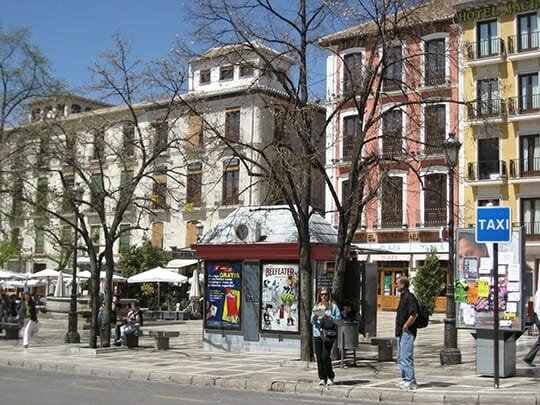
The beautiful Plaza Nueva was steps outside our apartment

We completed that work around 15:00 (3 p.m.) and returned to our hostal with two goals in mind: to visit the market to stock the apartment refrigerator and haul part of our luggage to make the next day’s move easier. Unfortunately, the market was just closing for siesta (had to learn that schedule) so we went to the apartment and dropped the luggage and put our feet up. We oriented ourselves, found the silverware, plates, ironing board, towels, etc. We had been given new sheets and bath towels as part of the rental.
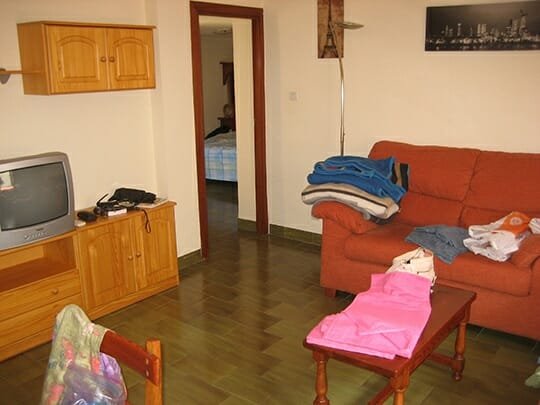
Our new apartment

The week-long holiday of Semana Santa commences this Saturday leading up to Easter. It should be spectacular and we have ringside seats in Plaza Nueva!
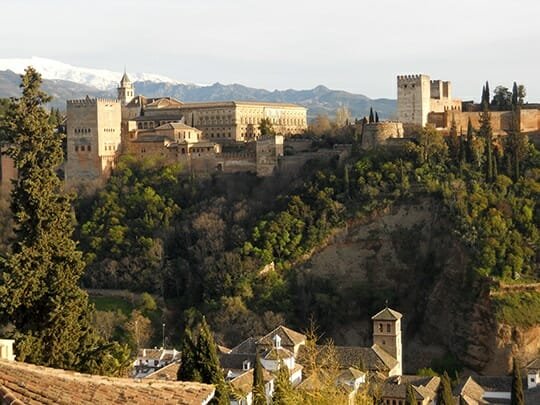
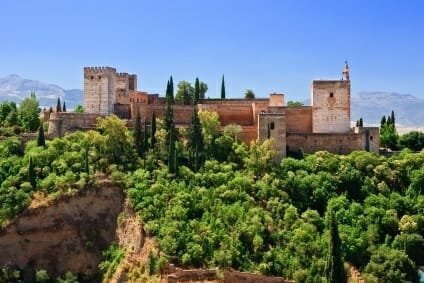
The Alhambra against the majestic Sierra Nevada mountains

“The most beautiful sunset in the world is in Granada.”
Bill Clinton, American ex-president.

Mark Blondin, the next road …
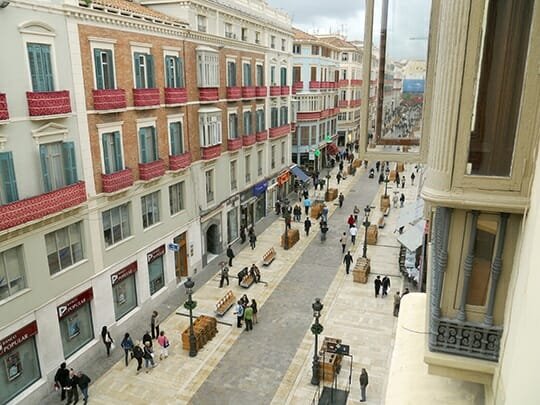
Málaga, Spain

Málaga, Spain

3/24/2010

Our plane  landed in Málaga, Spain on March 19, since then we have traveled to Ronda, Cadiz, Tarifa, and Gibraltar and now back to our beginning. Málaga is home to roughly a half-million people, about 100 km (62 mi) east of the Strait of Gibraltar and about 130 km (80 mi) north of Africa.

Note to self: do not enter large foreign city after dark looking for your hostel while driving a rented car and without a GPS device.

Street View from our Hostel Window

This time our hostel was well camouflaged along this busy walkway with a small sign of identification. After driving around and around honing in on this location, we parked along a dark and narrow street to proceed on foot. After entering the large wooden doors we hiked up a flight of stairs to check in. This hostel came highly recommended and lived up to its billing but it ain’t easy to find. The next morning we took the above photo from our room. I can remember only one hostel more difficult to find and that one was buried along the winding streets of Seville, Spain.

A bit about the city… Málaga’s history spans about 2,800 years, making it one of the oldest cities in the world. Founded by the Phoenicians around 770 BC, it was ruled by the Romans from 218 BC. After the fall of the empire it was under Islamic Arab domination until 1487 when Spain finally seized control. With the fall of Málaga, Granada became the only Moorish-controlled city on the Iberian peninsula after 800 years of rule. The archaeological remains and monuments from the Phoenician, Roman, Arabic and Christian eras make the historic center of the city an open museum.

Today, Málaga, while definitely a major economic center, has generated a growth in tourism served by Malaga Costa Del Sol Airport, one of the first in Spain, the fourth busiest and the oldest still in operation. The Port of Málaga is the city’s seaport, operating continuously at least since 600 BC. Rail service from the María Zambrano station connects Madrid and Barcelona with the new high-speed line making the trip to Madrid in considerably less than three hours. All of which, along with the great weather with lots of sunshine and Southern Spain beaches, makes Málaga a tourist destination but also a home to a sizable expatriate population of Brits and Germans.

For our visit, we targeted the birthplace of Pablo Picasso and the Museo Picasso Málaga, and the Gibralfaro castle which is next to the Alcazaba, the old Muslim palace which offered panoramic views of the city for our brief time in Málaga.

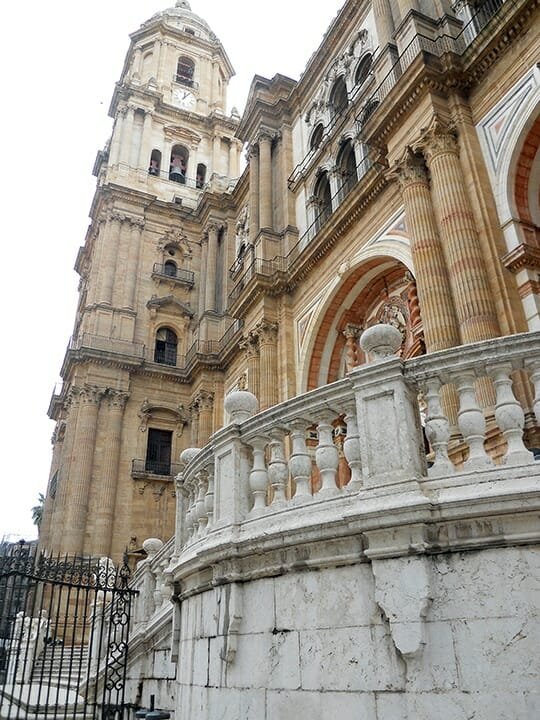
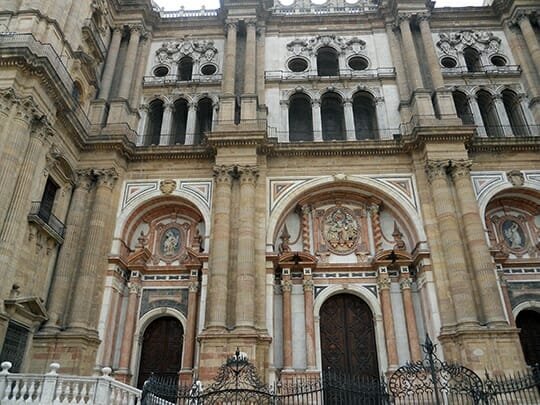
Cathedral of Málaga

The Cathedral of Málaga was the first major cathedral we visited after arriving in Spain. This Renaissance-style cathedral was constructed between 1528 and 1782. Two hundred and fifty years is incredible. The size and scope defies comprehension.

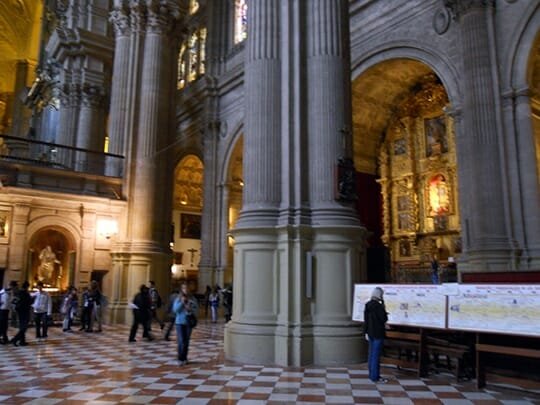
The inside is an awesome experience as one gazes at the enormity, the detail, and craftsmanship.

Inside the Cathedral of Málaga

The north tower rises 84 meters and is the second-highest cathedral in Andalusia, behind the Giralda of Seville. The south tower is unfinished. There are disputes on where the funds disappeared to, but because it is unfinished, the Cathedral has been nicknamed “La Manquita,” or in English, “The One-Armed Lady.”

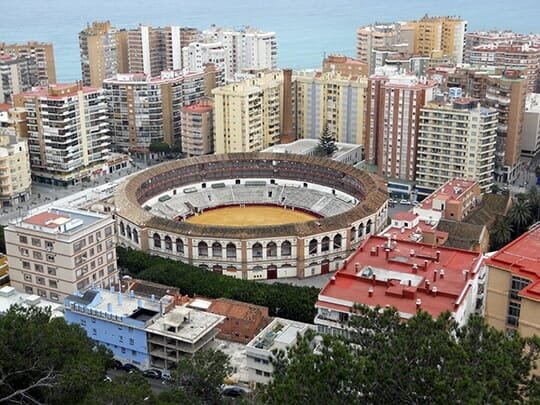
Having enjoyed visiting the birthplace of Picasso and the relatively new museo we took off for the walk up the hill to the Gibralfaro Castle with huge views over the city, including the Plaza de Toros de Ronda, one of the oldest operating bullrings in Spain.

The next road leads to Granada, Spain, where we will rent an apartment, experience Semana Santa, and immerse ourselves in the city for the next two months.

Mark Blondin, the next road …
 

Tarifa

Tarifa

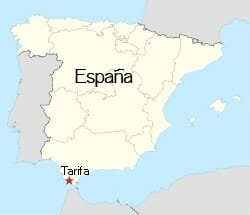
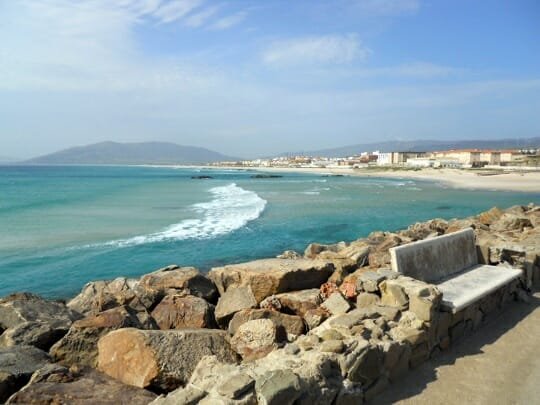
Tarifa offers a historical and beautiful setting with Morocco a short 10km across the Strait of Gibraltar, a gateway between the Atlantic and the Mediterranean. Beaches, natural beauty, climate, and location combine to make Tarifa worth seeking out.

The wind here is legendary. This is a mecca for all wind-related water sports attracting the best from around the world. While steeped in a long history, it has the feel of a California beach town but more international. The city is relatively small (20,000). We caught a picture-perfect day with the wind blowing in all its glory.

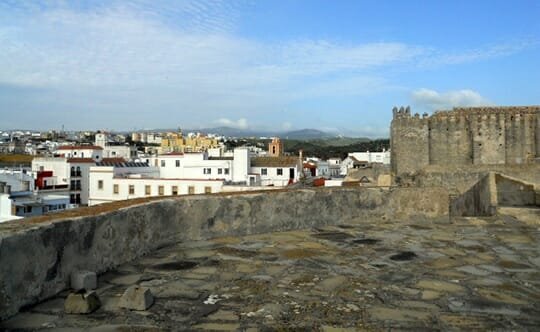
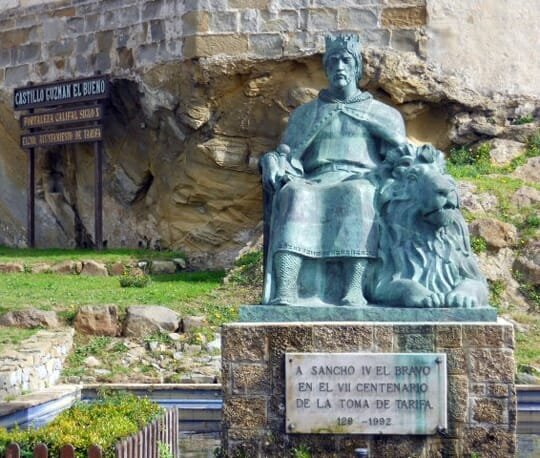
The best view of Tarifa can be had from the battlements of Castillo Guzmán el Bueno (castle of Guzman the good) who earned his moniker by refusing to hand over the castle in 1296 to the besieging forces of the Infante, Don Juan, and the Moors in exchange for the life of his son (good story).

A statue of the hero stands in front of the castle:

Tarifa has a hippy element which may account for the nice selection of vegetarian restaurants. We ate at a combination yoga center and restaurant called Tarifa EcoCenter and met an interesting German woman who came to Tarifa to visit her boyfriend and stayed. The city has that kind of appeal.

Beyond the natural beauty and wonderful climate, Tarifa offers the annual African Film Festival, dedicated to African cinema.

For the naturalist, Tarifa serves as a key point of passage for migrating birds between Africa and Europe. For birdwatchers one of the most impressive sights over the Straits is when flocks of storks, sometimes numbering up to three thousand, cross en mass relying on thermals and updrafts which occur over narrower expanses of water.

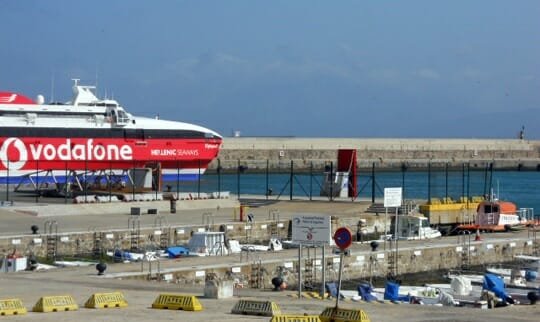
It was tempting to take the shuttle to Africa...

but with reservations in Malaga, we headed East along the Costa del Sol to arrive by nightfall.

Cádiz, Spain

Cádiz, Spain

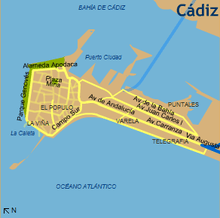
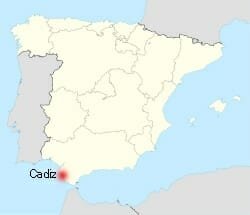
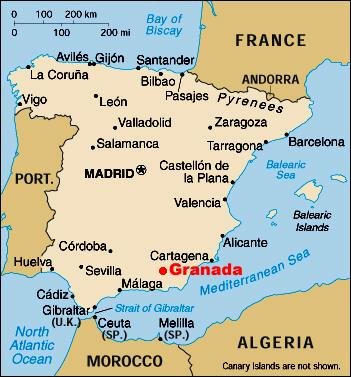
The map at left shows the relative location of Cádiz while on the map to the right you can see its unique position on a peninsula with the old city located at the end. Cádiz is said to be the oldest continuously inhabited city in Europe, founded in 1104 B.C.

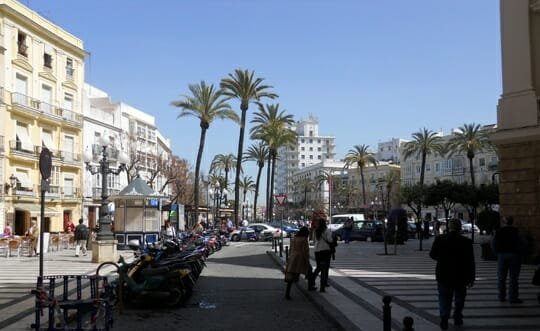
The old city (Casco Antiguo) within the remnants of the city walls consists of a labyrinth of narrow streets connecting large plazas. Fought over by the Phoenicians, Carthage, Hannibal, Rome, the Moors, and the Visigoths, Cádiz is awash in history.

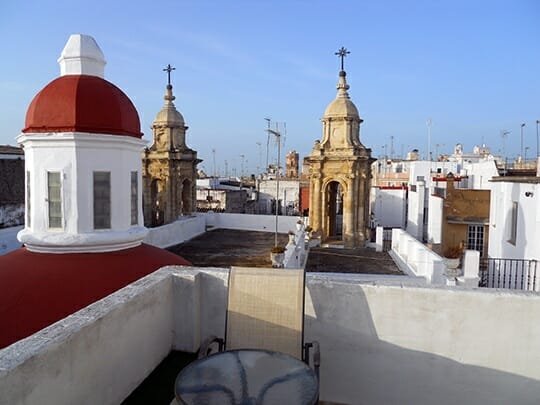
The view from our hotel rooftop evoked a sense of the Casco Antiguo.

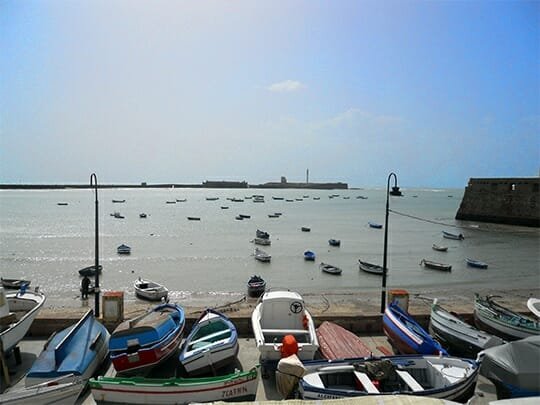
The lure of the city was everywhere. Along the waterfront, boats perched on the sandy beach brought the fishing heritage of the city to life.

The old city is easy to walk, it is confined to an area 1200 by 800 meters yet filled with bustling plazas and parks.

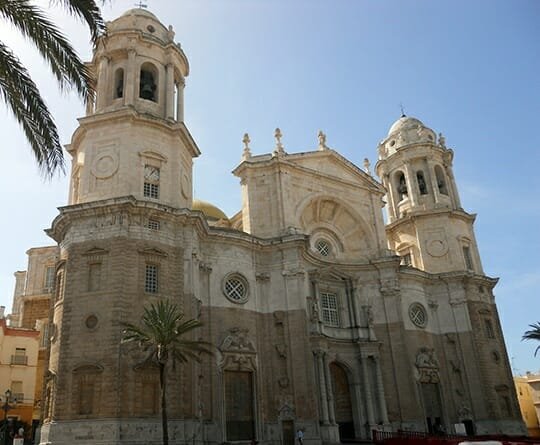
The Catedral de Cádiz is a stunning building...

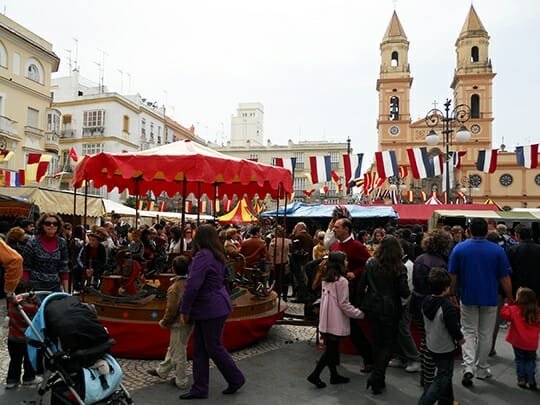
On a beautiful Sunday afternoon we walked this festival filled with booths of crafts, foods and collectibles in Plaza de San Antonio. The festival was packed with people sampling cheeses, dulces and local faire. The garlic pan (bread) with the local jamon (ham) with a side of on-the-spot-made potato chips cooked in olive oil was too hard to resist. Andalucia is an olive-producing center that prides itself on its product.

Our original plan was to rent an apartment here, spend a couple of months, study Spanish, and soak up the sun while immersing ourselves in the city. We had some apartment possibilities but could not quite land the right apartment. After a few days, we decided to move on.

We were ready to explore more of Andalusia so we rented a car and headed south toward Tarifa.

Semana Santa in Granada 2010

Semana Santa in Granada 2010

As we enter the Holy Week 2011, we take a look back at Semana Santa in Granada, Spain, 2010. We are told there will be celebrations here in Buenos Aires and a larger one in Luján, which is a two-hour bus ride from here. But in Spain, cities like Seville and Granada have few rivals for the Holy Week celebration. Happy Semana Santa 2011!

We wrote an account to families and friends last year...

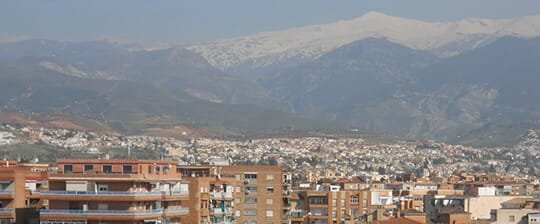
Granada sits at the base of the Sierra Nevada Mountains in Southern Spain. Semana Santa began during our second week of a month-long stay in Granada, Spain.

There is just no way to capture the scene around this festival. Nightly we have seen people in the tens of thousands crowding the street in a sea of humanity as religious processions pass. Most of the stores have been shut since Wednesday. The festival continues well into the morning hours. While the temperatures have been cool at night, crowds stay huge well past midnight.

Background

Holy Week (Latin: Hebdomas Sancta or Hebdomas Maior, "Greater Week" in Christianity) is the last week of Lent and the week before Easter.

The week begins with Palm Sunday (Passion Sunday), we all know that one. Not so familiar, Holy Monday (or Fig Monday), Holy Tuesday and Holy Wednesday (sometimes called Spy Wednesday). This quickly gets complicated for many of us. Toward the end of the week things heat up, there is Maundy (Holy) Thursday and of course Good Friday. On Holy Saturday the celebration of Easter begins after sundown. Easter Vigil is the longest and most solemn of the Catholic Church's Masses, lasting up to three or four hours.

Setting:

Our base for this Holy Week celebration is an apartment we rented next to Plaza Nueva in the Albayzin neighborhood at the base of the Alhambra, a Moorish citadel and palace in Granada.

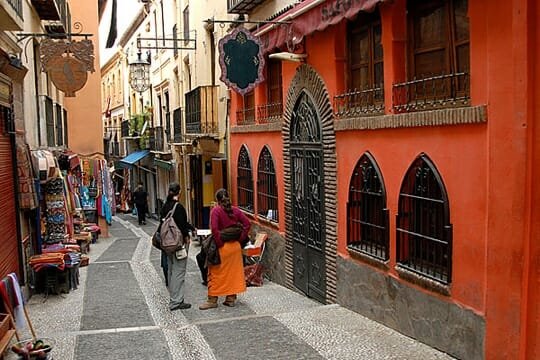
To further define our choice location, the Albayzín (also written as Albaicín) area of Granada is the Moorish quarter of the city that retains the narrow, winding streets of its Medieval Moorish past. It was declared a world heritage site in 1984, along with the more famous Alhambra.

With such fundamental human history being re-enacted this week, the omnipresence of the Alhambra with its own religious heritage provides a somewhat trenchant perspective on the entire celebration.

The Alhambra, literally "the red one," is a palace and fortress complex completed early in the 14th century by the then Moorish rulers. The history of the time period is a rich testament to Moorish culture in Spain and the skills of the craftsmen and builders of this era. Moorish poets described it as "a pearl set in emeralds" in allusion to the color of its buildings and the woods around them. Read more if you get a chance. I believe it is the number one tourist attraction in Spain.

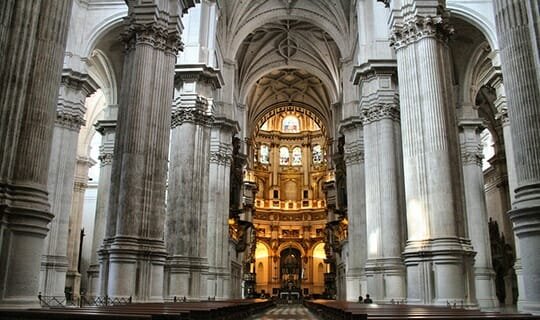
After the Christians conquered Granada in 1492 (another interesting story), the cathedral of Granada was begun in the early 16th century atop the site of the city's main mosque (not nice) and completed over a hundred years later. There is just no way to capture the scope and grandeur of cathedrals of this period. Here you get a glimpse.

So now you have the setting for Semana Santa in Granada, Spain, where Muslim and Christian cultures have intertwined for centuries. Let the 2010 Semana Santa begin...

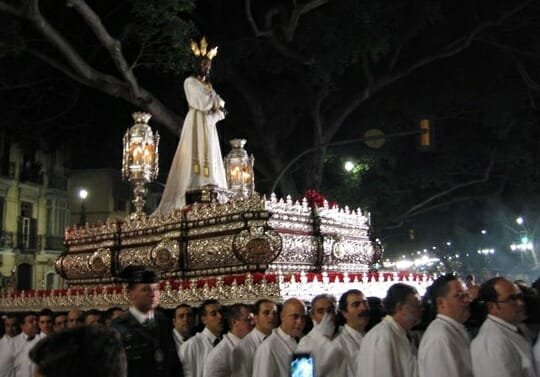
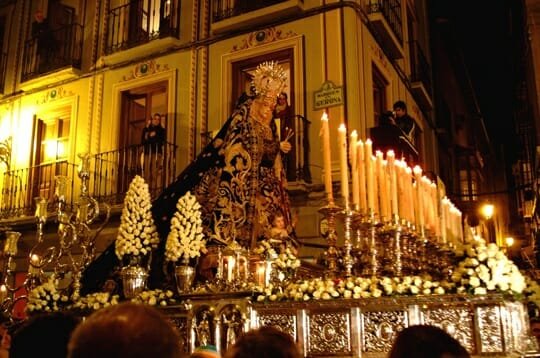
Granada has 32 brotherhoods belonging to the city's many churches and therefore, 32 breathtaking processions. The figures representing the scenes on the pasos are life-sized. In essence, the processions represent the Easter Passion, the story between the Last Supper and the Resurrection.

The entire scene is alive with color and sound. Emotions are stirred by the slow rhythmic beating of the drums and mournful sound of trumpets. The only way to get a sense of the drama is to watch some of this YouTube video.

http://youtu.be/yn1AbWnqv4I

The pasos are carried on the shoulders of men called costaleros, 20-40 per paso. What makes this amazing is that they are under the float and out of sight when the paso is in motion. And you have to remember that the streets, especially in the Albayzín neighborhood are barely wide enough for a single small car to traverse. This is athletic artistry at work and is wildly appreciated.

Since they cannot see where they are going, they follow the instructions of the capataz who walks in front of the paso, beating the ground with a stick to communicate. The basic maneuvers are simple, achieved with a shuffling movement of the feet. The difficulties come when the float must, for example, turn a particularly tight corner in a narrow street. This tedious maneuver is often applauded by spectators. Another crowd-pleaser is the swaying of the paso.

A typical float, which can weigh up to 6 tons is carried by up to 40 men. Footnote: According to this article, in 2011 women are now included.

Remember, this goes on for several nights and into the early morning hours. The crowds are enormous. Even to a non-believer, this historic event repeated year after year for centuries has no real parallel.

I hope this gives you a sense of Semana Santa. If you go either to Seville or Granada for Semana Santa, plan well ahead.

P.S.

Here are a couple of YouTube videos of our neighborhood in Granada:

http://www.youtube.com/watch?v=t2rAW1hXvYI

http://www.youtube.com/watch?v=LyV3W0GRs_A

And of the Alhambra:

http://www.youtube.com/watch?v=JDaodQLm8C8

http://www.youtube.com/watch?v=7MLKaVkEZxA